Personal Stories
A personal history of the 15th
Engineers and
1/84th Artillery as told
by those who were there in Vietnam

Listed below are the personal stories of members of the 15th Engineer Battalion, Combat and a personal story from Randall K. (Doc) Logan, 1/84th Artillery.
Click on a title to view. Click the Back button to return to here.
There are two "stories" about the "Ben Luc Bridge" below and detailed maps and photos have been posted of the Ben Luc area. For views of the photos/maps select "The Ben Luc Bridge(s)" below. Confused - don't worry: just read all articles about the Ben Luc Bridge. History is not an easy subject. The Ben Luc Bridges are no exception.
Bridge Children Vietnam 1967 and today by 1st Lt John Mayo C Company 66/68- Posted April 18, 2011
Ambush at the Kinh Xang Vietnam, March 1969 by 1Lt Richard Coogan - posted 2/25/2011
Ben Luc Pontoon Bridge "Anchor Away", Vietnam, July 1968 by Col Morton Roth - posted 8/3/02
Float
Bridge at Ben Luc, Vietnam, July 1968 by SFC Carter Glass
- posted 6/23/02
Redux Vietnam, Vietnam, 1967-1968 by Col Thomas Loper - posted 5/4/02
FSB Jaeger, Vietnam, 2/25/68 by Randall K. "Doc" Logan - posted 5/11/02
FSB Cudgel, Vietnam, 11/17/67 by James Deister - posted 2/25/02
Driving The 15th S3 And Some Questions About A Firefight, Vietnam 1967 by Ron Titus- posted 4/10/05
The Ben Luc Bridge(s) - posted 8/3/02: photos and maps - info only (Webmaster)
Introduction:
It was March 1969. I was the platoon leader of 1st platoon, B Company, 15th Combat Engineer Battalion 9th infantry Division in the Mekong Delta. I had a reinforced squad working on a land clearing site NNE of Dong Tam – Dong Tam was the base camp of the 9th Infantry Division and home to the Mobile Riverine Force (MRF) known as Task Force 117 by the Navy.
The Story:
Earlier in the day I was out with my reinforced squad on the land clearing site but had to return to Dong Tam for a Battalion meeting. At about 4PM (1600 hours) I was pulled out of the Battalion meeting to respond to a radio call from the Sergeant in charge of my reinforced squad that was clearing jungle. The radio contact was garbled but two words stood out – ambush and wounded. They had been returning to Dong Tam so I knew approximately were they were. I grabbed an extra bandolier of ammunition which gave me about 380 rounds of ammunition and headed out in my jeep to locate them.
The jeep got to about 70 yards of where they were and I spotted the radio antenna, I called the driver to stop. Going any further would invite an RPG. I told the driver to take cover and not to follow me. Muzzle flashes from the jungle across the Kin Zang (canal) briefly set my mind to wondering what my chances of covering those 70 yards would be. Open ground with no cover or concealment. Freshly plowed jungle with only dozer tracks as concealment. My calculation was zero percent. I ran to my men anyway. Bravado? No. I was the leader and my men were in a hurt. They were my responsibility. Irrational? Maybe so but I was their leader. It was my job. There was no other choice. I zigged and zagged, rolled and whatever. At one zagg, that landed me on my face, my magazine detached from my M16. It was a hard hit but better than a bullet. The dried Mekong Delta silt was as hard as concrete.
Okay, I made it to the radio and thankfully the wounded where there, one mortally and the other minor. The situation was not ideal. No smoke grenades and no medical kit – all had been left on the duce-and-a- halves when the troops baled during the initiation of the ambush. The troops were scattered and where not in defensive positions. Luckily, the attack came from across the Kin Zang (canal). The enemy, whom I thought were VC could not cross the canal easily. My priorities where two: suppress the enemy and Dust-off (Medevac) the mortally wounded man. Hoffman from HHC – a dozer driver. His dozer had been hit by a RPG and hot shrapnel had pierced his chest where his heart was, little blood – possibly the hot shrapnel had cauterized the wound but also he may have been bleeding internally.
I tried getting artillery to suppress the enemy – no luck and then a Cobra gunship pair came on my push. Thank you Battalion. I had no smoke to mark my position but I explained to the pilots that our position was obvious and they were to destroy anything across the canal from our position which they eventually did.
Battalion wanted know who the wounded were. All officers wear a code book around their necks and there was no way I was going to take the time to encode Hoffman’s name and company so I went to the Army’s phonetic alphabet – Hotel Oscar Foxtrot Foxtrot Mike Alpha November – Hoffman. Dead silence from battalion. They had no clue. Finally I went open mike and said “Hoffman, HHC.”
The Cobras were on the way and I needed a Dust-off ASAP to get Hoffman out. He was dying in my arms. That proved to be a problem. The Dust-off pilot said the Pick-up (PZ) zone was too hot to land in. I told him I could give him suppressive fire and that he should come in. He refused and stood off. I went ballistic and called him every dirty name that humanity has ever conjured up. I referred to his family tree as branchless because he had been inbred. I was pissed. He finally came in and I helped carry Hoffman to the Dust-off.
While trying to get the Dust-off in, I was holding Hoffman in my arms and when the Dust-off was on final approach I lifted Hoffman’s head so he could see the Medevac coming in and I told him that it was his freedom bird that would take him home. He had been semi conscious for most of the time I was with him. The biggest thing was to keep him from going into shock and I thought that mentioning home would keep him alert. It seemed to help.
Using foul language on the radio is a no-no and I thought I would be racked over the coals by my battalion commander. Using an open mike to state a casualties name is also a no-no. I had broken both rules. Nothing was ever said.
Hoffman survived – barely. The Doc said he had less than a half hour to live when he arrived at the 9th Med Mash unit.
We dragged our downed equipment back along with an artillery track mounted Bofors which had come out to support us. It had broken down and never fired a shot. On my last day of active duty I was flying a red-eye from Seattle to JFK, NY and met up with an Atry officer who remembered the ambush. He said the Arty LT in charge of the tracked Bofors had received the Silver Star for his actions that day. Really?
Epilogue:
The world is not perfect but you live with it. An ARCOM with “V” device was fine with me. I was just doing my job.
Major
Roth (retired COL) was S-3 (Operations), 15th Engineer Battalion,
Combat – 1967/1968
I was delighted to see 1st
SGT Carter Glass’ write-up on the Ben Luc float bridge that was built in early
July ‘68. I had wanted to relate another aspect of that operation for a long
time, as it was rather unique; his write-up was all the impetus I needed. I too
have a fuzzy recollection of some of the facts going back 35 years, and I
especially regret not being able to recall the names of all the troops who
worked this project and were so deserving of recognition. In my book they are
all heroes, then and now.
As
early July ‘68 came I was ending my tour as S-3 (Operations) for the Battalion
and was due to rotate back to the States. As I suspect is natural, I wasn’t
hoping for another Tet and thought I’d just ease onto that freedom bird and
peacefully fade away.
When
I went into the S-3 shop at O-dark thirty that 1 July 1968 morning the
Operations Sgt. greeted me with the news that the Ben Luc Bridge had been blown,
cutting the primary route to Saigon from the Delta, which, among other dire
consequences, caused the price of rice in Saigon to go up by some bazaar amount
each day the bridge was out. I immediately went into the denial mode. In a few
more weeks
I would have made a clean get away. It seemed like forever but when the Ops.
Sgt. repeated the dreaded news a few seconds later, I came back to reality and
after coordinating with any and everyone who knew about float bridging, learned
that the ARVN (Army of the Republic of Vietnam) would be putting in the float
bridge.
Although
I can’t recall how it came about, but suspect I got direction from Col. Loper,
I learned that the ARVN needed support and tasked Capt. Best (C, Company) with
the mission. The float bridge went in in very good time, thanks in part to the
efforts of the 1st platoon, C Co.
The
float bridge had been placed on the up-stream side of the permanent bridge that
had been blown. The river at that location was tidal and it was secured to the
blown bridge at various locations, which prevented it from moving up-stream as
the tide came in.
To
secure the float bridge during an outgoing tide, a 2-inch diameter wire rope had
been strung across the river, up-stream of the float bridge, and anchored on
both banks. (See 1st SGT Carter’s story “Float Bridge at Ben
Luc” regarding installation of this cable)
The
up-stream cable anchors were an issue. There was no way to predict if the
anchors would hold as the days and weeks went by. That, plus any debris or other
things the bad guys might float down the river to take out the float bridge,
caused a good deal of concern. An additional up-stream restraint was needed to
secure the float bridge during an outgoing tide.
I
had some time before seen a huge ocean-going ship anchor in the depot in Saigon
and thought why not? Plop that
thing in the middle of the river with a fan of cables running from it to the
float bridge and that bridge wasn’t going anywhere.
I
don’t know how he did it, but Maj. Stu Williams, the S-4, had that anchor
delivered on a flat bed the day after I asked him to get it.
In the mean time, I arranged for a flying crane, CH-54, to lift the
anchor and place it in the river. Must
have asked for it the day after the anchor got on site, as we had to hook cables
of various lengths, with floats, to run from the anchor to the bridge and
arrange to have the crews in boats to do the attaching.
I can’t swear to it but I must have tasked C Co with that mission as
well as they were familiar with the operation.
Must not have been 1st Platoon or Sgt. Glass would certainly have
remembered that aspect of the operation. Well,
the next day came and everything was ready.
The
CH-54 arrived mid morning, let out its cable and was hooked onto the anchor.
And like an elephant letting out a mouse fart, lifted that anchor about 6
inches off the ground and no more. The
lift capacity of a CH-54 is something on the order of 22,000 pounds (11 tons).
So that anchor must have weighed with cables and all maybe 6 or 7 tons,
well below the max lift capacity of the CH 54. Somewhere in the back of my mind
is the figure of 13,000 pounds, which would make sense.
Must have got that number from the depot documents, but whatever it was,
it was too much for that time of day. The
mid-morning heat reduced the air density, reducing the lift capacity of the
chopper. Scratch that day.
Told
the chopper to be back as early as possible the next day and had the cable on
the anchor that the 54 would hook onto shortened as much as possible so as to
gain lift through ground effect of the chopper’s rotors.
Next
day every thing went like clockwork - almost.
Chopper arrived early, hovered as low as he could, was hooked up to the
anchor, lifted off without a problem, out to the middle of the river, enough up
stream to allow for a fan of cables, with floats attached, to run from the
anchor to the bridge. The hookup crews in boats were ready to do the job.
I’ve got the chopper on one frequency and the guys in the boats on
another. Gave the OK to the chopper
to lower the anchor to the riverbed and drag it a little way down stream to set
it. That seemed to work as he
couldn’t drag it any more and the chopper started to tilt sideways, making for
one nervous pilot. Gave the OK to
release the cable -- and nothing happened.
As explained to me, the release mechanism is an electrically activated
device. It shorted out in the water
and wouldn’t open.
Told
the pilot to lift the anchor and drop it when the release mechanism was clear of
the water. He thought about that
for a few seconds and thought the jolt from a sudden release of such a great
weight might throw the chopper out of control and he didn’t want to risk it.
A good chance he could be right and I didn’t need an accident
investigation to extend my tour. Brought the anchor back to the flat bed on the Saigon near
side shore. By then too hot for any
more attempts so released the CH 54 and asked him to be back early next day
while we tried to come up with a solution.
Next
plan was to have the anchor lifted with a shorter cable and bring it to the far
shore where a crew would remove the short cable, attach a long cable to allow
the chopper to drag the anchor out to the middle of the river.
The cable would be long enough to keep the release mechanism clear of the
water. Crews would get the floating
tie cables to the bridge and we’d be in business.
Anyway, that was the plan. Early
next morning the chopper was on site (probably with one PO’ed pilot), short
cable attached, lifted off without a problem, over to the far shore, crews
standing by to attach the long cable, boat crews with the float supported tie
cables, chopper lowers the anchor to the ground, and from what I understand, it
just kept going down, down, down into the muddy bank.
That anchor wasn’t going to be dragged anywhere.
Well,
making the best of what you’ve got to work with, as good combat engineers are
supposed to do, tied the bridge to the anchor where it was.
Left a few days later for the land of the big PX and have no idea if that
rather bazaar approach to anchoring a float bridge stood the test of time.
But I'm sure that anchor isn't going anywhere.
In a 1,000 years when archeologists come across that anchor, they'll be
scratching their heads as to what it’s doing there.
For
that whole operation I spent the entire time on the site, sleeping on the ground
on the blown bridge overlooking the float bridge.
Next to me was the Provost Marshal who also spent the entire time there
and also slept on the ground. I didn’t want to waste time going back and forth
as it all started early and had other things on site to take care of, and the PM
was there to oversee traffic and supervise control of the civilians using the
float bridge. One night woke up as a group of captured VC came by under ARVN
guard. That was the closest I came
to the bad guys.
I
may have overlooked some aspects but the essence of what I’ve written is how
it was. Maybe some of the guys on
shore or in the boats have photos of a CH-54 flying with a sea anchor hooked to
it, or can add or correct anything I may have misstated. Again my regret is that I didn’t personally thank the guys
who did the work. If you’re out
there now, please accept a much belated “thank you” for a most unusual job
well done.
And now you know the rest of the story. If you're wondering what happens to engineer S-3 Majors with strange solutions, they wind up as engineer O-6's with strange solutions. Called it quits in '87 after 30 years and would do it all over again if I could. I'm afraid health problems may prevent me from attending the next reunion, but I wish the best to all of you
|
Float
Bridge at Ben Luc, Vietnam By:
Sergeant First Class Carter Glass Introduction - All
of the accounts in this story are from my memory, photos, and other
papers that I have saved for the past 35 years. I retired from the
Army in 1968. My version of the following does not by any means intend to imply that other accounts or memories by other people are the same as mine. With this in mind, here is my story of the 1st Platoon, Company “C”, 15th Engineer (Combat) Battalion, 9th Infantry Division, APO San Francisco 96370 and its involvement in the spanning of the float bridge across the river south of Saigon on Route 4, leading south into the Mekong Delta. Tan
An, South Vietnam : July 1968 location of Company
“C”, 15th ECB
Commanding
Officer: Captain Tom Best On
or about the 1st of July 1968, Captain Best informed me I
was to call a meeting of all Platoon Leaders and Platoon Sergeants in
the mess hall at 11:00 hours for a briefing on upcoming operations At
this time I was the Acting 1st Sergeant for the Company.
The meeting got under way around 11:00 hours and Captain Best talked
of the upcoming operation, which was to put a float bridge across the
river (the Song Vam Co Dong) near Ben Luc, and that Company “C”
had the mission of aiding and providing technical advice and
assistance to the ARVN Engineer Unit on the far shore. The pontoons
would be assembled and made ready to put on the river by them. After
Company “C” had prepared the access road and approaches to the
bridge site (south), we were to make ready the anchorage system on the
near shore (south), and prepare the guy lines. Upon
completion of the bridge, security, maintenance, and upkeep of all
access roads would be the responsibility of the ARVN troops. A
personal note here : I did not say anything to Captain Best, but I had
a lot of experience with ARVN security or rather the lack of it,
(while at Tan Tru) which allowed “Charlie” to blow the south
section of the main bridge on Route 4, while the ARVN Company in
charge of security on the south side slept (‘nuff said). Captain
Best then invited questions and comments. Of course there was some
concern as to our part in the operation, but the meeting was kept as
short as possible, and the Company Commander informed me, that we
would move to the site as soon as we could get our vehicles loaded and
all other preparations had been made. He
then gave us our assignments. The 1st Platoon would be
responsible for the near‑shore anchor system and assist in any other
way possible. |
|
The
2nd and 3rd Platoons were given the task of
preparing the access road leading to the site (south bank of the
river), and the approach ramps. They were also to assist with other
problems that could arise. Because none of us had ever viewed the
site, we pictured in our minds the worst case scenario foreseeable. After
the noon meal we prepared to move our troops and tools, and the
Commanding Officer led the unit out of Tan An. Getting to the site was
not difficult because of a small road leading from Route 4 down to the
river and the future bridge site. We proceeded with caution. On the
downstream side the ground was high enough to provide cover and
concealment for our vehicles, while the upstream side was a different
story. The terrain was flat, swampy, and had rice paddies, but no
cover. Arrival at the Ben Luc Site - As
I recall, the Company arrived on site about 15:00 hours. A real short
recon of the area was conducted by each platoon to cover their
designated area of responsibility, and as much security as possible
was put in place. About
one hour later, we began receiving small arms fire from the upstream
side of the river, not heavy, but enough to be dangerous. Lt. Scott
and I were near the river when the firing took place, but there is not
much one can do except try to find the source of the problem and
eliminate it. I
asked for two volunteers to go with me up river to seek out the
snipers and “take care of them”, if possible. The first man to
step forward was our Platoon Medic,” Tony” and one other man whose
name I can’t recall, but I had what I needed. We
walked away from the river, about _500 yards down the access road to
get away from the river and then continued upstream, about ¼ mile or
so. Then we headed down to the river, getting as close as we could
without entering the swamp area. We proceeded downriver looking for
the source of our problem to no avail. “Charlie” was too well
hidden and the firing continued during the whole operation.
Fortunately nobody was wounded. Establishing an Anchor System For the Pontoon Bridge -
I
remember we got back to the Platoon and began our recon to find a
suitable place to install the anchor system. The ground behind the
mangrove swamp was two to three feet below the water level and
provided no place to install a system that would hold. We held a short
meeting at the future site of the anchor system to discuss the problem
we faced. |
After some discussion, we came to the conclusion the only way to do the job was to use two Bailey Bridge panels (pinned together),and to pull them up against the mangrove roots. To do this, we decided to use demolitions and blast a large and deep enough hole behind the mangroves to put the panels in place. We agreed that three 5 pound charges would do the trick.
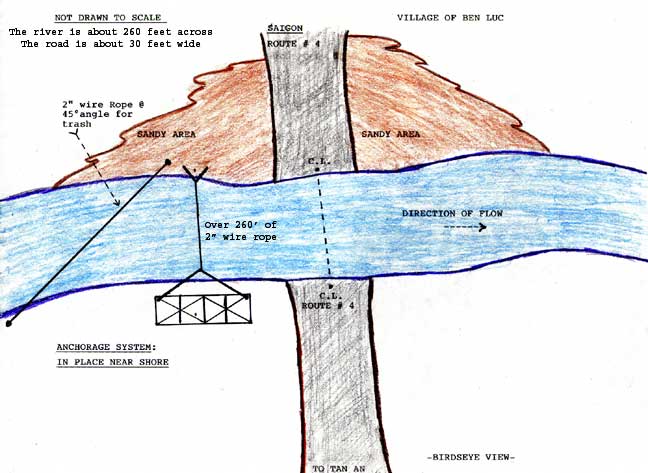
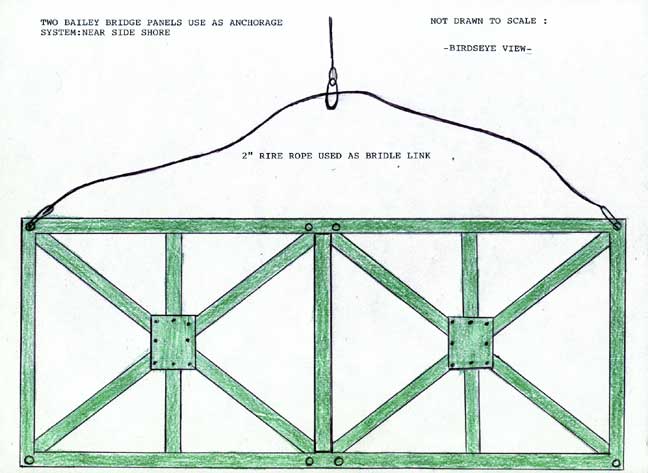
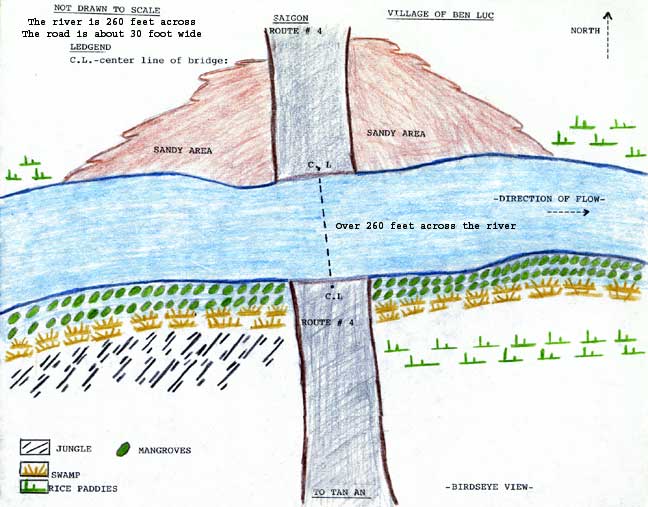
1 - General layout of where the anchoring
cable and debris clearing cable were located upstream of the actual site of
the pontoon bridge (noted by the C/L or center line on the drawing).
Understand the drawing is NOT to scale.
2 - A drawing of the two Bailey bridge panels used to provide the south
anchoring system in the mangrove trees
We
spaced the charges five feet apart, and wired in series primed with
electrical caps, then placed the charges in the desired location, ran the
wires some 200 feet back, cleared the area, took cover and let it rip. Boy,
what a nice explosion We forgot that water is the best tamping material, but
we got the desired results. The crater was about four to five feet deep,
about 40 feet long, and about four feet behind the mangrove roots. Wading
into the crater to check its depth, we found it sufficient for the panels.
The charges had worked
The
only way to get the panels in place was by manpower, but by this time it was
too dark to do the job, and the cable could not be brought over from the far
shore by boat. We had no choice but to wait until daybreak the next morning,
when the ARVN troops would do this job.
Harassing
Mortar Fire And Wounded -
About
dusk we received several rounds of mortar fire along the access road and
near where we had been working a short while ago. Everyone took cover under
the vehicles, since they were on the road close by and provided the best
protection available to us.
I
remember that Sgt. Frank Givan was near the approach area to the bridge,
standing in water up to his waist, when the last round exploded near him.
Tony and I were by the platoon jeep and in a position to see Sgt. Givan fall
backward into the water. We rushed down to him and pulled him out of the
river. That was when Tony (Doc) told me Sgt. Givan had been hit in the right
side of his chest. I seem to recall Lt. Scott was on the radio immediate
calling for a dust off. Within minutes the chopper sat down on the access
road, Tony (Doc) and other medics had Sgt. Givan on board and on his way to
the hospital in Saigon. Tony (DOC) went along and did not return until the
next morning.
Meanwhile the Company made ready to spend a long night near the bridge site. I do not recall any other troops being hit by the mortar rounds earlier in the evening. The bridge site was quiet the rest of the night, “Charlie” being good to us.
|
The
morning brought some fog on the river and visibility was not the best.
We asked for a small detachment of ARVN Infantry to come across the
river to search upstream for any VC that could hold up the operation.
They did a good job, because we had no more trouble. About
07:00 Tony (DOC) returned by chopper from Saigon and reported that
Sgt. Givan was OK He had suffered a collapsed lung from a piece of
shrapnel, but he was already up and walking around and anxious to be
released for his trip home to the land of the big PX. The Company was
losing one of the best Engineers I have ever known, and I was losing a
very good friend and teacher. I would miss him very much as would the
entire Company. Positioning
The Anchor System And A Surprise From Victor Charlie - As
soon as we could, we began to move the panels in place. This required
a lot of manpower, but we accomplished the job and then requested a
boat from the far shore to bring the wire rope to our side. Everything
had been prepared, so when the boat was in position we attached the
line to our panels and sent the boat on its way to the far shore. As
the boat pulled away, the panels began to move slowly and were pulled
into place against the mangrove roots and trees. So far so good. It
looked perfect and communication by radio between the near and far
shore worked like a dream. Things worked out as we had planned, and
the anchor system was in place in spite of small arms fire during most
of our time on the river. The
ARVN troops on the far shore began to move the pontoons onto the river
and made the necessary hookups and adjustments. Around noon about
half of the pontoons were in place, but then “Charlie” came back
with a big surprise. Upriver he had cut down banana trees and rigged
them and other debris with explosives and firing devices, put them in
the river to float down to the bridge, hoping to destroy it before it
was ever completed. To prevent “Charlie” from succeeding, we
suggested that a large cable be run across the river at a 45 degree
angle to divert the debris to the far shore, where it would be sliding
along the cable upon impact. It worked, but some of the stuff
’became entangled in the pontoons and cables, and had to be removed
by hand and guided on down the river. This caused a lot of work for
the ARVN troops, but they rose to the challenge and did manage to keep
the river open.
Sometime during the afternoon I was instructed to return the 1st Platoon and our vehicles to the Company area at Tan An. The troops were a worn out and dirty bunch, but they had performed as well as they had on the other two bridge building projects. Mission accomplished!
|
|
A Short Timer And A Thank You To
All - I
cannot lay enough praise on the 1st Platoon for its
outstanding efforts under the most adverse conditions imaginable.
Medals for all the troops that had participated in this monumental
task should have been approved and issued. Thanks to the efforts of
Company “C”, 15th Engineer Battalion (combat), the
route from Saigon to the southernmost point in the Delta was again
open. The 1st Platoon did not witness the last pontoons
being put in place to complete the operation, because our assigned
task had been fulfilled. After
Company “C” returned to Tan An, and all equipment had been
secured, Captain Best gave us some time off to relax and get cleaned
up. I went to the Orderly Room to make up for lost time, getting
caught up on administrative details which I had missed in the past few
days. Reports and “paperwork” had to be done to get things back to
normal in the Company. Right
then and there it dawned on me that I was to return to the US of A in
the near future. But no word from HQs had arrived as to my DEROS.
Early on the 15th of August, word came down that I was to
report to the 90th Replacement Battalion, Long Binh, RVN
and that my DEROS date was 16 August 1968. With such short notice, Lt.
Kaye Scott, 1st Platoon Leader, told me he would take me by
jeep to the Replacement Battalion. We had to stop and pick up the
paperwork, so I could clear Vietnam. With all the rushing around I had
not cleared Company “C” of all personal equipment, and all I had
taken with me was my weapon, which I turned in at the Replacement
Battalion. The rest of my gear and personal items were left behind in
my room in the NCO Quarters in Tan An. Lt. Scott and I said our
good‑byes and he returned to Tan An. After
I finished processing, I was issued one summer uniform, which was all
I needed to go home to my wife and two children, who stayed in E1
Paso, Texas (Fort Bliss ). On the morning of August 16th, I
boarded the “Freedom Bird” for the trip home. Our first stop on
August 17th was Honolulu, Hawaii, then we continued on to
Travis AFB in California. After a short processing I was given a 14
day leave, until August 31st, which enabled me to celebrate
my 40th birthday ( August 24th
1968) with my family. On the 1st of September 1968 1
quietly retired from the Army without any fanfare. I
am very proud of the tasks Company “C”, 15th ECB
performed in Vietnam and equally proud that I had the privilege of
serving with such outstanding officers and enlisted men from 1967 to
1968.
OH
YES, I DID GET TO CROSS THE PONTOON BRIDGE ON MY WAY OUT OF VIETNAM!! |
|
Epilog
- I
have to state here that my Army career was cut short by six to eight
years due to politics that had taken place in Fort Bliss, Texas some 13
months before, when I was forced to decide between a tour of duty in
Vietnam with only 6 months until my current enlistment would have been
up or face discharge after 19.5 years of service, resulting in no
benefits for me or my family whatsoever. I did an extended tour in
Vietnam and was lucky to return to my family and retirement unharmed.
|
Redux Vietnam
1967-1968
By:
Colonel Thomas Loper,
Commanding Officer, 15th Engineer Battalion, Combat
Introduction -
My reason for writing about my time as Commanding Officer (CO) of the 15th
Engineer Battalion, Combat (EBC) is to personalize some of my and perhaps
other 15th EBC veteran's experiences while in Vietnam. The Operational
Report Lessons Learned submitted for the period 1 Jan. '68 - 30 Apr. '68,
as found on the 15 CEB Web Site is very dry reading. It really does not tell
the story of what went on, on a daily and personal basis, in the Battalion.
Since I was a major commands branch action officer, then Branch Chief, in
the Officer Personnel Requirements (OPXR) under DCS Personnel from June
1965 to Summer 1967, I was able to follow the buildup of Army troops in
RVN rather closely. The branch was responsible for filling deploying and
activating units with officers in the ranks lower than full colonel. I knew
who was going and when and when they would rotate. When the 9th INF Div
Was
activated at Fort Riley, Kansas, I took a special interest in the 15th
Engineer Bn. I knew Bill Read, the 15th's Commanding Officer (CO), who was
a classmate of mine from USMA, and I knew that I wanted to be his
replacement. At the appropriate time, when the requisition for his
replacement came across my desk, with my boss's permission, I walked it to
the Engineer Branch Chief, and said that I would like to replace Bill. That's
how I wound up as the CO of the 15th.
Arrival in Vietnam -
I departed CONUS on 24 Sep 1967, from Travis AFB on a charter flight, as
many of you did, arriving first in Hawaii, then Tokyo, and finally at Tan
Son Nhut AFB, RVN. I was processed in and for the night was put up in a
wooden barracks/BOQ. It was a quiet night. The next morning my driver, Sgt.
Whiteside (?), arrived with jeep and trailer. We loaded my gear, and off we
went, as I recall, in convoy with a deuce and a half with replacements for
the 9th Div. Sgt. Whiteside was a great driver and NCO, that he was
selected to drive for the Bn CO came from an action where he was awarded
the Silver Star.
When I arrived at Bear Cat, after an uneventful trip, we went straight to
15th Bn HQs and met LTC Bill Read the CO. After a few words of greeting
Sgt. Whiteside and I unloaded my gear in a tent, which had a wooden floor,
a fridge, and a shower. The lap of luxury! I can't remember what went on
the rest of the day, but that I met the Bn XO, Bill Rhine, and staff (Jon
Vandedbosch) and several of the Company COs (Neal Smart and Brink Miller)
who were located at Bear Cat. That evening, I met most of the Division
Staff and most likely, MG O'Connor, the Div CG. Col Maury Kendall was the
COFS (Chief of Staff) and he welcomed me and showed me around the
Division Headquarters and the Division Tactical Operations Center (DTOC).
Most memorable was the dinner that night at the General Officer's (GO's)
Mess, a converted "T" shaped mess hall that had been gussied up to
warrant
it's title. All arrived in newly starched fatigues and polished boots. I had
yet to take advantage of the local laundry facility, run as I remember with
a steel hand of a rather good looking mamsan, so I fell a bit below the
sartorial standards of the GO's Mess. We dined well, on white tablecloths,
non-GI silver and glassware. Food was well prepared and served. After
dinner, the group, GO's, the Division General and the Division Special Staff
(being the Bn CO of the 15th Engineer and therefore the Division Engineer I
was a member of the Division Special Staff), assembled in a lounge where we,
at least most of us, relaxed in overstuffed arm chairs, smoked and sipped a
brandy while we watched the movie "Who's Afraid of Virginia Wolf"
starring
Liz Taylor and Richard Burton. Some Movie for my first night in the
division!
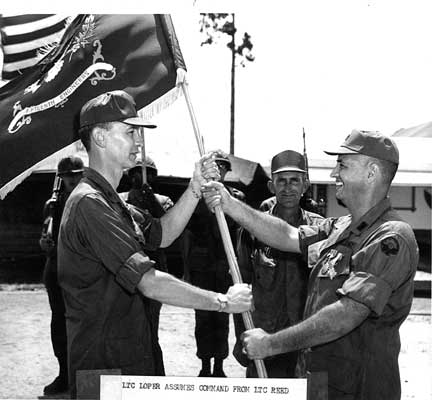
The change of command ceremony was held a Bear Cat on 30 Sep 1967, with
the Bn SGM Trent passing the colors of the Bn from Bill Read to me. MG G.G.
O'Connor, BG Morgan Roseborough, Assistant Division Commander Support
(ADC SUP), and BG Bill Fulton, Assistant division Commander Operations
(ADC OPS), attended the ceremony, as did the II Field Force Engineer, Col
Art Surkamp and several of the battalion commanders whose units supported
the division.
Swimming in a Drainage Ditch -
On evening shortly after my arrival, I was invited over to the 214th
Aviation Bn mess for dinner. The CO was an old engineer friend of mine,
LTC Bob Standley. We had a few drinks, a fine dinner, and after dinner we
smoked a cigar and drank brandy until I felt that it was time for me to get
back to my hooch before I fell flat on my face. I left the mess hall; walked
past the outdoor theater which was full of GI's watching a movie, sneaking
under the screen and hoping that I was unnoticed. I got to the ditch beside
the road that divided our Bn area from the 214th. There was a plank bridge
across the ditch, which I was carefully negotiating, not seeing the
"burnout
barrel" right in my way. The rest of the story was funny, ha, ha. I wound
up
in the ditch, not smelling very good! Got to my hooch and took a long shower
with my fatigues and boots on. Finally feeling fairly clean, I dried off,
undressed and fell into my cot. So much for heavy drinking in RVN!
Getting Organized -
Two major tasks faced the battalion when I took over, first was preparation
for an Army Inspector General Inspection, which I was not prepared for in a
combat zone, and neither was the battalion, and the second was planning for
Operation Santa Fe, which to my mind was the biggest operation that the
battalion was to undertake while I was in command. Other engineer activities
continued, base construction at Camp Martin Cox (Bear Cat), including
perimeter bunkers, mess halls and barracks, roads and helicopter parking and
revetments, and base construction at Dong Tam in the Delta.
The IG Inspection covered all of the normal subjects; it also included a
visit to a base camp by CH-47. There were at least 15 inspectors that
pounced on our small Fire Support Base (FSB) not far from Bear Cat. I
suspect that the FSB was a lager area for one of the Bn's Rome Plow
operations. The inspectors stayed for lunch in the field and poked around
the perimeter looking for items to report. They found two: around the
perimeter berm, there were several small bunkers; in them they found a
mixture of high explosives (hand grenades) and Pyrotechnics (flares). That
was a no-no to be stored together! I argued that it was an operational
necessity to have both items close at hand on the perimeter. The item stayed
in the report. The second was much more serious, the rinse water in the mess
line was not hot enough! Ouch. At the exit briefing given by the IG Team
Leader to the CG and as I recall, Gen Abrams, the battalion came through the
inspection with flying colors, thanks mainly to all of the hard work by the
WO's, NCO's and men.
I recall an unfortunate incident that happened in late October, not long
after my arrival. While waiting for the dozer operator to finish his task,
the 5 Ton tractor driver got sleepy and crawled under the low boy for a nap.
When the D7 operator couldn't find the driver, he started the 5 Ton tractor
and ran over the young soldier, SP4 Kee, and killed him. My driver and I
arrived at the scene after Kee had been evacuated. The subsequent
investigation came to the conclusion that it was an avoidable accident.
Sleeping under any piece of equipment became an Article 15 offense.
I also visited the Thai Regiment in the northern Rung Sat Special Zone from
time to time by chopper, delivering ice cream from the new ice cream plant
located at Bear Cat. I went to advise the Thai's on base security and
discuss engineer support, not to deliver ice cream. On one of these runs, a
warning light came on and the pilot put the chopper down just outside the
RTVR (Royal Thai Volunteer Regiment) perimeter. Upon alighting from the
chopper, I noticed that we were in an antipersonnel minefield. Back into the
chopper to wait for the pilot to diagnose the problem and fly into the
compound. When I advised him where we were sitting, he was motivated to
get back in the air ASAP! Usually on these visits we were invited for lunch,
which consisted of typically hot Thai food, but good!
Operation Santa Fe -
During the weeks of preparation for Santa Fe, I toured the division's Area
of Operational Responsibly (AOR) by jeep and helicopter, meeting the C
Company CO, Tom Best, and men in Tan An, and the D Co, CO, Capt Allen, in
Dong Tam, as well as the Bn Forward Headquarters, AKA Task Force Ripsaw,
headed up by Maj Dave Lewis. I was also afforded a recon of the Santa Fe
AOR in an H-23 piloted by a terrific Capt, from the 3/5 Cav, who had been
shot down several times. Needless to say although we flew route QL 1 from
Xuan Loc to the II Field Force boundary at ridiculously low altitudes, there
were no VC waiting to shoot us down and the recon gave me good insight into
the roads, destroyed bridges, and terrain. Santa Fe, with our mission to open
QL 1 from Xuan Loc to the II Field Force Boundary, kicked off on 3 Nov 1967.
We
started out our convoy from Bear Cat consisting of HCC, A Co, B Co, and
E Co, looking like Rommel's Desert Rats with our Helmets, Flak Jackets and
Goggles. We were ready for bear, most jeeps and 3/4s had their floors
sandbagged and windshields down and sand bagged. We found the latter
precaution was dumb as we immediately cracked the windshield! Our first FSB
was at the foot of a mountain, perhaps NUI BA DINH, just east of Xuan Loc,
unfortunately my map of the Div AOR stops at Xuan Loc. A perimeter had
been dozed and on the inside was a 175mm Gun Battery. Our lager was just
outside the perimeter as there had been no VC activity for some time. We
pitched tents and settled in for the evening, to be awakened by the 175's
throwing shells right over our heads at targets some 15 miles away. Almost
blew down the mess tent! I think that we either moved into the perimeter
the next night or hightailed it down the road to our next FSB.
A Land Clearing Team of Rome plows under opcon of the 86th En Cmbt Bn
(Army) had been working both sides of the "highway", clearing swath of
several hundred yards on either side of the road. Santa Fe was also a
combined operation with the 1st Bde, 3/5 Cav, 9th Div, 11 ACR and a Bde
from the 18th ARVN Div, (which was located in the vicinity of Xuan
Loc).
The
mission of the troops was to find and eliminate any VC forces in the area
and to provide security for the engineers. We also had a Panel Bridge Co.
from II Field Force to haul and provide technical advice on building the Bailey
bridge. We had trained with the bridge back at Bear Cat during the prep
phase of the operation. One of the first things to be done, once we
encamped at FSPB (Fire Support Patrol Base) Wildcat some 18 or 20 miles
East of Xuan Loc, at the edge of the May Tao Secret Zone, was to do a
thorough recon of the 11 to 13 bridge sites which had not been seen for
years by US Forces.
Road and Bridge Reconnaissance -
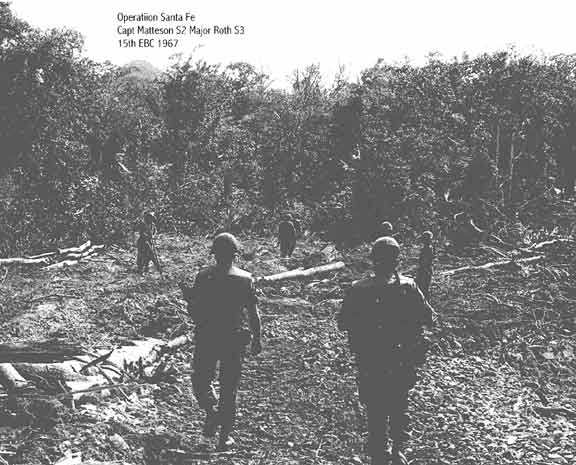
One overcast morning we set out, myself with driver and shotgun, the S3,
S2, and recon section, and probably some others, Company CO's etc., in three
or four jeeps with ACAV's from the 2/47 Inf providing security. It was
eerily quiet as we drove down the road, which had not seen a vehicle since
the French departed 12 years before. The only sign of life were elephant and
other large animal droppings that littered the road. The Armored Cavalry
(ACAV) commander asked permission to clear his weapons and do a bit of recon
by fire. I gave him the okay and in minutes the calm was shattered by the
ACAV's machine guns and not being one to hesitate I told our guys to unload
a magazine into the bushes as well. In less than a minute I had a call on
the radio from the FSPB asking what was going on, were we in a firefight or
what. I replied that we were just doing a little recon by fire. The order
came back to knock it off, we were giving away our presence to the VC, as if
they did not know we were there!
The bridge recon proceeded one site at a time, the group fording the many
small streams that the earlier bridges spanned. It had begun to drizzle as
we arrived at the last bridge, and I received a radio call from the S3 that,
the II FF Engineer was inbound by helicopter and wanted to meet me at a
small Province airstrip several miles back along the way. The purpose of his
visit, without prior notice, was unclear, but driver, shotgun, and I
divorced ourselves from the recon and drove through the mud and rain back to
the rendezvous. When we arrived the colonel's chopper was waiting. I told my
driver to seek cover from the rain and I would return as soon as I found out
what the colonel wanted. It turned out that he wanted to look over another
abandoned airstrip and see if it would suitable for improvement. We took off
in the rain, found the airstrip in question, landed in the mud and quickly
determined that it was not worth our effort to do anything with the strip.
Back into chopper, back to where my driver and shotgun were waiting, albeit
a little wet and worried, then back to the FSPB. The colonel never did ask
what in the hell was I doing off of the FSPB. The recon group returned
shortly and the S3 and S2 group set about calculating the panel bridge
requirements, site by site.
Opening QL1 -
We already had one section of Panel Bridge (PB) on hand, which was sufficient
to rebuild the first bridge, which was a three span, triple single Bailey
several hundred feet long. We ordered up the remaining bridge sections as
they were needed, pressing into service, not only the PB Co.'s bridge
trucks, but our 8 Ton Bridge Trucks from E Co. Altogether, the Engineer Task
Force built 13 bridges, eleven on QL1 and two on highway 2B which led to the
fishing village of Ham Tan on the coast. Opening this road led the Province
chief to throw a party for the Task Force, which consisted of lobsters and
other Vietnamese delicacies. As I recall, some of our guys got into Ham Tan
and were showered with lobsters, which they brought back to the Wildcat and
shared with the troops. Over 1000 feet of bridge were built in ten days,
exceeding the most optimistic estimates by the division and II FF. I was not
surprised, as I knew how well the 15th Engr Bn units worked together, and
how enthusiastically the men put their shoulders to the task. The key to
the success of the operation was the detailed recon performed on arrival at
the FSPB, which was done without the knowledge or consent of the Division
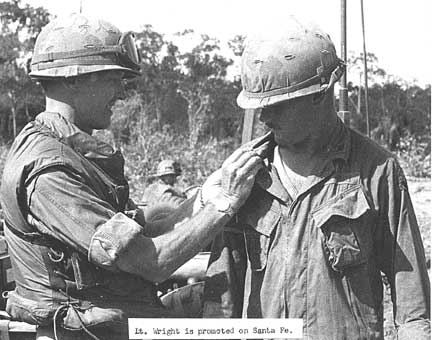
Hqs. I had the pleasure of pinning Lt. Wright's silver 1st Lts bars on while
we were in the filed. We crossed the II/III FF border and did some road work
in the III FF AOR. The combat operation was modestly successful, with a few
VC KIA and some weapons captured. As we know from history, most of the VC
had withdrawn from the Mai Tao Secret Zone to their pre-TET attack
positions.
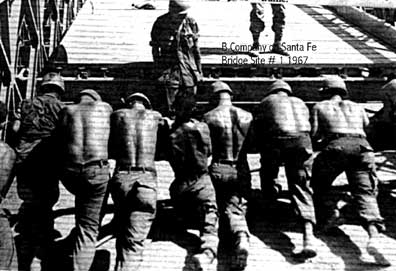
One interesting sidelight, while we were at FSPB Wildcat, the Army/Navy
football game was played in Philadelphia. It was broadcast over AFVN very
late one night. In order to stay awake for the game, the officers assembled
in my tent for some beer and poker. We all lasted until about 0300, when I
had to throw them out and get some sleep. Army lost! While at Wildcat we
maintained several Listening Posts (LPs) in the jungle just outside our
perimeter. We listened to the guys in the LPs, as they got nervous,
commenting to the TOC that they heard noises out in their sector, we never
had a probe of anything larger than a wild pig, but it was scary. We
returned in convoy to Bear Cat before 1 Jan. 1968, where we cleaned and
maintained our vehicles and equipment. I was also able to get a new
windshield for the jeep. This was to be the last of the large operations,
which involved most of the 15th Engr Bn as a unit.
After Sante Fe, I was tasked by the G3 to take a look at the defenses of
the Radio Rely/Sensor readout center on Nui Ba Din. Took an 0H 6 from Bear
Cat to view what the infantry had in their position on the mountain. Arrived at
the base of Nui Ba Din in a dense fog, pilot snuggled up to the slope and
worked his way up to the top of the hill. Could not see zilch until we broke
out of the fog/cloud at a few feet from the top. Was met by the Infantry
Platoon Leader, and given a tour of the perimeter. There were many problems
where the wire had been left unrepaired; claymores were not positioned to cover
gaps in interlocking bands of fire, etc. I covered all of the deficiencies
with the lieutenant, and said he had better get his shit together. A week
later Nui Ba Din was hit with a big VC force, which was repulsed with minimum
casualties. Chalk another one up for the engineers.
After Santa FE -
Days were spent between Bear Cat and Dong Tam and construction was
accelerated of the division camp in the Mekong Delta. I spent many hours in
Hueys and Beavers, and even several flights in C7 Caribou's between the two
camps. Having no assigned or attached air transport meant that I had to beg
assets, or hitchhike a ride whenever I had to get to Dong Tam in a hurry.
Often, my driver, shotgun and I set out by jeep, through Saigon and Cholon
down QL4 to Dong Tam. We usually stopped in Tan An to visit and lunch with C
Co., Tom Best, later Dick Scharf, and the 3rd Bde. Sometimes in a convoy,
but just as often as a single vehicle, traveling at 50 mph. Never had a
problem. The hairy part of the trip was on the connecting road from QL4 to
TL24 (from My Tho) and then on TL4 into Dong Tam. I recall, two civilians
were killed when their truck was blown by a command-detonated mine not a
half-mile from Dong Tam. Later, on the same road, a VC launched a RPG from
a tree line about 150 yds away that passed behind a flame track and in front
of my jeep. Talk about acceleration! Another instance on the connecting
road, the Div Provost Marshall was traveling in his jeep, without escort,
and was ambushed, initiated by a mine. In the firefight, one MP Lt was KIA
another was WIA, the Div PM might have been slightly wounded, but received
A SS
and a Purple Heart for the action. One of our HHC Security Platoon 3/4
Ton's was a kilometer behind and sped into the firefight and drove off the
VC. They then took off cross-country in pursuit of, what turned out to be,
several VN farmers. As a consequence of this little firefight, a stray
round, of unknown origin, found its way into one of the artillery batteries
ammo dumps at Dong Tam, which proceeded to blow up, taking with it one of
the newly completed mess halls. I was afforded an excellent view of the whole
action courtesy of LTC Pete Selleck, CO of the 86th Engr Bn, who just
happened to have a chopper standing by.
Back at Bear Cat on New Years Eve, about midnight, the perimeter erupted in
furious gunfire, with illuminating rounds going off at will. After being
rudely awakened and summoned to the Bn Hq, I was advised by the SDNCO
that the Camp Commander was yelling for a cease-fire. We contacted our
bunkers and relayed the order and gradually the firing ceased. It was
embarrassing, but our troops were not the only ones blowing off steam. In
comparison to Dong Tam, however, Bear Cat was a sea of tranquility. I can't
remember more than a couple of times when Bear Cat was mortared or
received incoming fire of any sort.
TET 1968 -
When TET exploded in Jan/Feb 1968; the division and the battalion had one
foot in Bear Cat and the other in Dong Tam. As I recall, I was in Bear Cat
that night of the beginning of the VC offensive, and except for some minor
skirmishing on the perimeter, we had little activity, and neither did Dong
Tam for that matter. Of course, that was not the case along QL4, Tan An,
and all of the Vietnamese Regional Forces/Popular Forces (RF/PF) outposts in
the division TAOR. Hard hit were also the 7th Army of the Republic of
Vietnam (ARVN) Division training center, just to the East of Dong Tam, and
the 7th ARVN Division Headquarters in My Tho. My Tho was heavily
engaged,
with the 7th ARVN Division and District Headquarters', with their US
advisors under siege. The Mobile Riverine Force (MRF), the 2nd Brigade, 9th
Infantry Division, along with a platoon from "D" Co. 15th Engineers
rushed to
reinforce the defenders and throw back the VC, who were probably from the
214th MF Bn, and the 514th LF Bn. In heavy street to street, house to
house, fighting the 2nd Bde and the engineers were able to clear the town of
VC in a day or so. Our engineers fought as infantry, which, of course is the
secondary mission of the combat engineer. One Lt, Plt Ldr, performed in an
exceptionally valorous matter, and was put in for a Silver Star. The MRF was
called upon to move troops throughout the Delta during the succeeding weeks.
Life at Dong Tam was punctuated by nightly mortar attacks, which increased
during the TET offensive, and soon began to include 107 and 122/140mm
Rockets, which were normally launched from the area across the KINH XANG
Canal West of the camp. A mortar/rocket spotting team was placed high in on
of the radio towers. They had a compass rose and a siren and as soon as they
observed the flash of a mortar or rocket launch, they cranked up the siren,
plotted the azimuth and estimated range to the launch site, called this into
the artillery, and within minutes 105 mm howitzer rounds were on the way. It
also became habitual to have a couple of AH1 Cobras in orbit over the canal,
and occasionally a Spooky AC-47. The fire from these aircraft was nothing less
than spectacular, and they sounded like a chain saw. In spite of the frequency
of the attacks, which came nightly for several weeks, there were few
casualties and limited damage. One instance, on 17 June 1968, was easily
remembered. That night we had pretty much turned in, we were in the two
story barracks/BOQs by then, the siren sounded and we bounded into our
bunker, which also served as our officer's club and movie theater. Several
rounds came quite close to the battalion area, one landing between the
generator shed and the BOQ, just outside WO's Magnusson and Flannagan's
(Bn EE Repair) room. It blew holes in their air conditioner and refrigerator.
Ah, the perks of being the Bn S4. Another landed very close to the HHC
Mess hall, just across the road. We had just had a cry for help from a GI
visiting in the next barracks; he was not briefed by his engineer hosts and did
not know where the bunker was. We managed to get him inside just a little
shook up. We then had a call on the phone located in the bunker, it was from
one of the cooks, and he was in the mess hall and had been hit by shrapnel.
I ran out, grabbed my helmet and flak jacket, told the medics to get to the
mess hall, pronto, and then ran across the road to the mess hall where I found
the GI on the floor holding his leg. I pulled away his pants leg and found that
he had a puncture wound behind his knee. He was not bleeding, but was
somewhat in shock. I talked to him until the medics arrived in less than five
minutes. They took over and applied first aid dressing and evacuated him to
the MASH. He was treated and sent to the 24th Evac in Saigon, then home.
He told me the reason that he was in the mess hall was that in a previous
mortar/rocket attack all of the mess personnel from another unit went to their
bunker without turning off the M48 Stoves - the end result, the mess hall
burned down! He went to make sure that the stoves were off. What a
guy!
Opening the Mekong Delta - Food for Saigon -
The first operation, right after the fighting from TET slowed down was to
open QL4 from My Tho to Cai Be, and then to Vinh Long across the Mekong
River. QL4 between the My Tho intersection and Cai Lay had been interdicted
in fifteen or twenty place with craters, ditches, and berms. An engineer
convoy consisting of front loaders, dump trucks full of sand, and a D5 Dozer
from the airborne kit that the battalion acquired, left Dong Tam in the
early morning with some security provided by the 3/60th mechanized infantry
and our own security platoon. We arrived at the first obstacle, which as I
recall was a berm across the road with a ditch behind it. After checking for
booby traps the front loader filled in the ditch with the dirt from the
berm. A major problem developed when another mech infantry outfit started to
get in the way, saying that they had an ongoing operation North of the
highway near Cai Lay, after some debate between myself and the mech bn CO,
I told them that they could go around the work if they wanted to. This meant
that they had to leave the road and negotiate the swampy paddies. They tried
and promptly bogged down, but with some of our help we got them going and
out of our way.
Although we had a jeep, we walked nearly the entire 8/10 miles to Cai Lay.
A scary moment occurred when the front loader had to get around a crater to
fill from the far side. I would swear that the machine leaned at a 30-degree
angle over the paddy before getting safely to the other side. There was a
great degree of urgency to this operation as a convoy of bridge trucks was on
it way from Saigon to deliver Panel Bridge to the ARVN at Ap My Hung, where
the long QL4 bridge over the Mekong River had been partially destroyed. We
were just filling the last crater near Cai Lay, using the little D5, when the
convoy came into view. Backing and filling the dump trucks on the narrow
two-lane road was quite a feat in itself, but we finished up and waved the
panel bridge convoy through. We loaded up and drove back to Dong Tam after
a grueling day. Another remarkable job done by the 15th.
The following day I had the opportunity to fly down to the bridge site and
observe the ARVN engineers building the panel bridge to replace the downed
span. It was as long as 150 feet, so it was necessary to build an inclined
launching nose, of about 50 feet, then using a crane with a long boom on a
barge below the bridge, slowly guide the nose out to the undamaged pier, all
the while, adding one side of double single bailey panels, bay at a time,
until the nose rested on the rollers on the pier. Quite an impressive
engineering job. Once the single panel was in place, it was secured, and the
nose dismantled. It was getting dark so we flew back to Dong Tam. The next
day we made another run down QL 4, perhaps with BG Knowlton, as we were
going on down to Vinh Long and Can Tho for some meetings. As we flew over
the bridge site, lo, there was no bridge. Somehow the crane operator had
nudged the span and it collapsed into the river. Although, some panels were
recovered, an urgent call went out to Saigon for more bridging. The bridge
was eventually completed without further incident.
Another interesting incident occurred shortly after TET, the concrete bridge
at Cai Lay was partially destroyed and had to be completely removed. For
some reason, we were given the mission of delivering a huey load of
demolition's to and ARVN unit, which was going to blow the debris,
permitting the construction of a Bailey replacement. The unit was located
near a small village, Ba Dua, south of Cai Lay, which shows a chopper pad on
the map. I remember sitting in the back of the Huey with the C4, cradling
the box of blasting caps on my lap. Don't recall who went on that flight
with me. But, we found the pad, found someone who could speak enough English
to know why we were there, unloaded the explosives and handed over the caps
and bugged out for Dong Tam.
We had a water point at Cai Lay, which I visited from time to time; the
water was for the town and for a nearby FSB. Talk about being isolated, in
lousy conditions, but doing a job. One day when my driver and I had been
out to the water point at Cai Lay and visited the RF/PF outpost, and FSB, we
were headed East on QL4 when we noticed an ARVN deuce and a half, partially
in the ditch on the side of the road. It was full of civilians and there
were some injuries. As we approached the accident some VC in a wood line
about 200 meters south decided to get our attention. Evidently they had
earlier fired on the truck causing the driver to lose control. We took cover
behind the jeep and prepared to return fire. But, the VC quit shooting and
we since did not have a decent target, we turned to the injured civilians.
One woman had a small child who appeared to be seriously injured. I was able
to get on the radio and call in a Dustoff, who arrived promptly and took the
woman and child into the civilian hospital in My Tho.
Guard Duty at Dong Tam -
The 15th Battalion sector of responsibility for the Dong Tam perimeter was
across from the Navy's ship basin, near the area of the Division ammunition
dump. This was an area, which previously contained an extensive Nouc Mam
factory. Though it had ceased production before Dong Tam was completed, it
consisted of several huge vats, about 20/30 feet in diameter and 10 feet
deep. There were the remains of the stuff that the locals used to make their
Nouc Mam - corn, greens and other delicacies. These vats drew rats the size
of large cats. Before building the ammo dump we got the job of blowing the
vats and covering up the area. Once done, we built our bunkers along the
riverbank, just to the South of the dump. The berms around the ammo were
probably close to 25 feet high and 75 feet thick at the base. One of our
chores as Division Security Officer of the Day was to inspect the perimeter
at night. It was rather spooky to drive around to the Battalion perimeter
bunkers and meet with our guards. They had night vision equipment, which
included one large scope, A/N-PVS-5, with which you could look across the
river into the jungle on the far side. One night, after TET, the VC were
lucky enough to put a mortar or rocket into the ammunition dump, which blew
several cells. The ammo consisting mainly of 105 and 155mm howitzer rounds
which exploded with spectacular results. Naturally, we were concerned about
our guards in their bunkers nearby, landlines were taken out by the
explosions, and don't recall that we had radio commo with the bunkers. We
went by jeep around the basin and past the now quiet ammo dump to the first
and closest tower/bunkers. The men were shaken, but were not hurt, as was
the case with the other towers. They had hunkered down in the lower level
of the bunker and waited for the explosions to finish. Not much damage was
done to the well-made 15th Engr bunkers!
Showers, Mortars and Air Cushioned Vehicles -
One of the early highlights of living in Dong Tam were the showers down by
the Navy's boat basin. If you wanted a shower, that's where you went and
hoped that the VC would not drop a few mortar rounds on a bunch of naked
GI's and a couple of officers. They didn't, but we were happy to get our own
showers built in the battalion area.
Another small incident occurred at the Dong Tam airstrip in the middle of
the day. We were there waiting for a chopper, when the VC decided to drop a
few mortar round on the field just to get out attention. It did, though the
closest round was probably 50 yards away, and we dispersed into whatever
cover we could find. I picked a culvert while several others dove under a
lowboy. When the rounds stopped coming in we emerged, dusted ourselves off
and felt a little sheepish, until we looked at the lowboy and discovered
that it was loaded with artillery ammunition. The PSP strip suffered a
couple of small holes, most likely just 60mm mortars.
About the same time, the division received two large air cushion vehicles.
Fortunately, they were not assigned to the battalion for maintenance as we
had already been assigned, a bunch of Boston Whalers with 40 HP outboards
to maintain, as well as number of airboats. This equipment was furnished under
the "Ensure" Program, which got somewhat experimental equipment into
the
field before operation testing. Good idea, but often not a practical
solution to a particular problem. The Boston Whalers and the Airboats were
used in the Delta, Long An Province, around Dong Tam, and in the Rung Sat
Secret Zone, South of Bearcat. The Air Cushion Vehicles were used in the
Delta when and where boats and vehicle could not go. Unfortunately, they had
maintenance and reliability problems, and were often seen suspended from a
Sky Crane on their back from the field.
One rather large operation involved the airboats, some whalers, and the air
cushions, was mounted out of Dong Tam and moved North along the KINH
XANG canal, that bordered Dong Tam on the West. The operation started
well with the airboats with infantry and part of the 15th Recon Section leading
the way, the air cushion vehicles (ACVs) were out in front by a mile or so. I
had the
opportunity to fly with one of the division staff, which was observing the
action. No action, so the convoy of boats started back down the canal. When
opposite the Dong Tam Airstrip, almost to the basin, the VC sprang an ambush
from the far side of the canal, beginning with a Claymore. Capt Stephen
Matteson, the S2 was in one of the airboats and took a full measure of the
Claymore, which blew him over the side. While the flak jacket probably save
his life, it certainly did not help him stay afloat. Only the quick thinking of
the
infantry platoon leader, who may have been KIA shortly after, saved Steve
from drowning. He plucked Steve up by the back of his jacket and threw him
into the boat. That we did not see the ambush coming was the result of a
sudden rainsquall that made our chopper sit down on the Dong Tam strip.
Steve was evacuated to the 94th in Saigon and then home to CONUS. I ran
into him several years later at an Engineer Ball at Fort Belvoir, he still
showed
the scars from his wounds.
Donut Dollies and Falling Towers -
I am sure that most of the men that were there in '67-'68 remember the 2
story barracks that we built for the Donut Dollies and nurses assigned to
the hospital. No sooner than finished, the WQ was deemed to be vulnerable
to peeping toms, so we hurriedly built a 10-foot high fence around the building
and had a guard post established to protect the women.
I clearly remember several incidents that happened early in Dong Tams
existence. The first was the falling tower in the vicinity of the old MASH
unit and mess hall. The 9th Signal Bn had built a humongous radio tower and
was raising one of several antennas to the top. Some how they were able to
drop the antenna a few feet, which cut one of the guy wires. Just as the
Camp Commander, several others and myself were leaving the mess hall, down
came the tower with the two men on top. We thought that the men were goners
for sure. When the tower hit the ground, it set up a huge cloud of dust, out
of the dust came the two men running for their lives. They were shook up and
sent to the MASH where they were pronounced fit. In the near vicinity, we
had just finished building a bunker over the trailer of the ADC (BG William
Knowlton). To this day we are not sure just how it happened, but the bunker
collapsed and flattened the general's trailer. We guess that one of our dump
trucks got a little too close and nudged the bunker. I believe that was the
last of our bunker over trailer projects. The rest of the trailers, for the
GO's and the COFS were placed near the division HQ not far from the DTOC.
9th Division Tactical Operations Center (DTOC) -
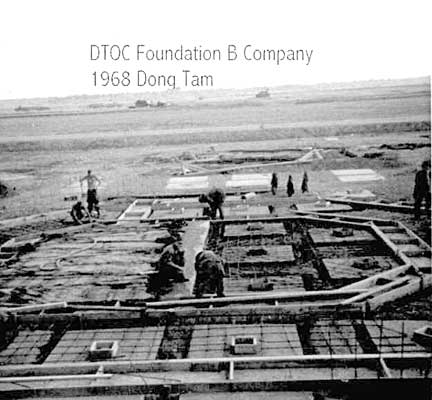
The DTOC, itself, was a super design and construction effort by the
battalion. Maj Mort Roth, the S3 and his assistant, Lt. Jack Rhyne were
tasked with the design. Lt. Rhyne had an EE degree, and Maj Roth was USMA
graduate, had his MSCE from Ohio State, by then. The result was
outstanding, and is probably still there to this day. Though, when the Chief of
Engineers, came for a tour of Dong Tam and was shown the DTOC, he
expressed concern that the building would sink into the sand before long. He
was a tough hombre to convince and I'm sure I did not make many points when
I opted to differ with him. The one deficiency in the DTOC was that the
electrical and communication wiring was placed in chases in the concrete
floor. They seemed not to thrive in such a damp environment and were
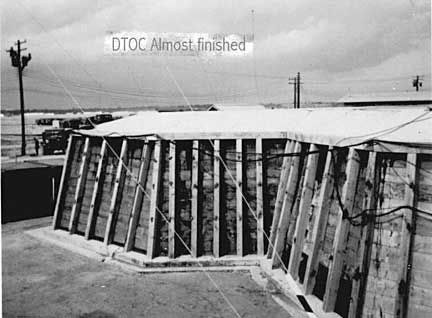
subsequently moved to the walls and ceiling. On the other hand, the big
signals bunker was another challenge. It was to house the division's crypto
facility and had to have a separate compartment for the "red and
green"
wiring systems and had to be shielded with a copper mesh in the most
critical areas. The building therefore had to be quite high to meet the
requirements. As a result, as the sand was being placed in the walls they
began to bulge. The solution was to buttress the walls with timbers giving
the appearance of Notre Dame.
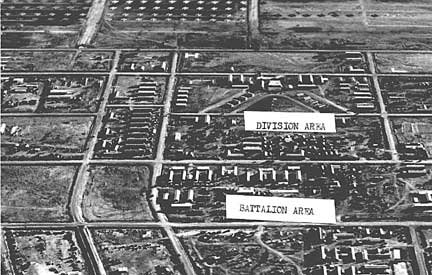
Mini TET -
The mini-TET offensive which started in April or May threatened Saigon
from the South from both Long An and Gia Dinh Provinces. There were many
firefights during this offensive action, I recall that the 173rd (199th?)
Inf Bde was employed in the defense of Saigon as well as the 5/60 Inf Bn of
the 3rd Bde. By this time, Col Ira (Jim) Hunt, a CE officer, had become
Division Chief of Staff (COFS), (later to be MG CG of Fort Belvoir) and Col
Henry (Hank) Emerson, later LTG and 18th Abn Corps CG, was CO of the 3rd
Bde at Tan An. Col Emerson was my Squad Leader during "Beast Barracks"
at
West Point in 1946. He was a righteous cadet, very quiet and thoughtful. I
stopped by the 3rd Bde Hq in Tan An one morning, and sat in on one of
his
briefings to his staff and battalion commanders, sat in the back of the room
like a fly on a wall. I'll tell you that Hank had morphed into a fire breathing,
hard swearing combat commander since he graduated from West Point. Col Jim
Hunt was two classes ahead of Hank's and they got together frequently, when
Hank went on R&R, or otherwise was absent, Jim was there to take command
of the brigade. More about them later. Though, Jim Hunt was a thorn in my
side from time to time, I made it clear that I commanded the battalion, not
the COFS, however, he did own my body as I was also the Division Engineer
and a member of the Special Staff. Fortunately, I had a great Asst Div Engr,
Maj Stuart Williams, who was able to keep Col Hunt off my back.
Ira Hunt, Friend or Foe -
One occasion illustrates my association with Col Hunt. He had to go to
Saigon for some reason, and was also going to stop at a civic action project
in Long An Prov. He requested my presence while at the new school. We left
Dong Tam, midmorning and arrived at a small chopper pad in the village where
we were building the school. We were met by an ARVN officer and most likely
the village chief. Col Hunt and I visited the project, which was practically
complete, then went back to the chopper pad. Hunt told me to wait for him
there, that he would be back from Saigon shortly. Though I had the company
of the ARVN Captain, it was a lonely village, where the VC had been active
in the not so distant past. After an hour or so, the ARVN Captain allowed
that he had something else to do and departed. I sat on a bench, under and
eaves of a wooden building for another hour. It started to rain like hell,
and visibility drooped to zilch. No chopper, no COFS. I was getting more
than a little anxious over what I was going to do for the night. My CAR-15
was my sole support and my poncho my sole shelter. It had just begun to get
dark, when I heard the whup-whup-whup of a Huey coming in for a landing. It
was a HU 1B gunship stationed at Bear Cat, which was returning from a
mission and, due to the weather, put down in the village. I ran out to the
chopper in the rain, and asked for a ride to wherever they were headed. No
problem. When the rain let up a bit later, we flew at about 50 feet, to Nha
Be, where the pilots and crew normally stopped for chow. We ate well, and
left in the dark for Bear Cat. Fortunately, the Bn still had a rear element
there and I was able to get a jeep to come out to the airstrip and pick me
up. Was I ever glad to get back to "civilization", though I asked Hunt
what
happened, he said that, they left Saigon later than expected and the weather
was too bad to come a pick me up. Yeah, sure!
The Ben Luc Bridge -
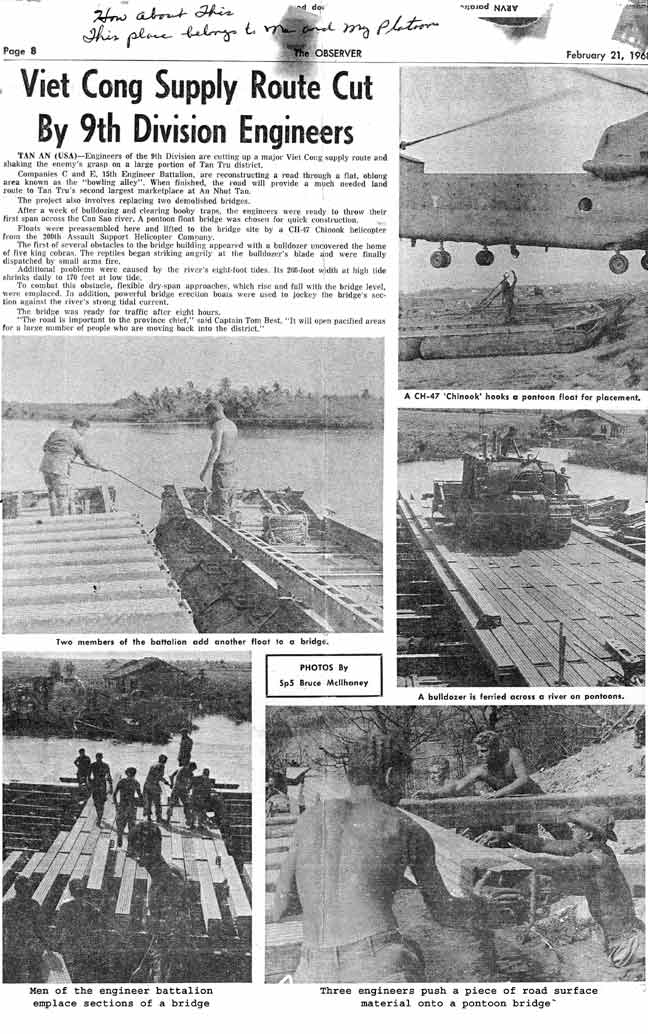
Another real interesting event came about when the bridge over the Song Vam
Co Dong at Ben Luc was blown by the VC in July 1968. The ARVN Engineer
Group had the mission of constructing an M4T6 Float Bridge across the river.
A platoon from C Co. of the 15th Engineers provided technical advice and
physical support, and installed the near shore guy wires. I went up with the
platoon from Tan An at night, as ordered by the COFS. Fortunately, the VC
were asleep and our convoy went up unmolested. First job was to prepare the
near shore access road and abutment. Don't recall what the platoon did that
night, probably, slept under ponchos. As for me, I was invited by an
Infantry Captain, who was a Province RF/PF Advisor to spend the night in his
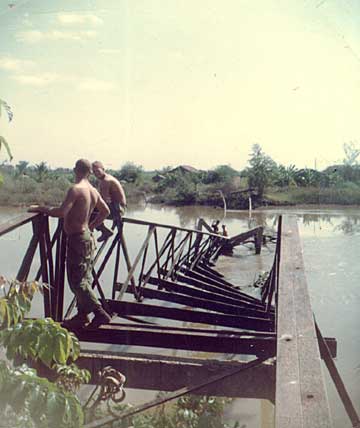
hooch, which was built into the side of the hill under the bridge. It was
better than nothing, but I found that he shared his modest dwelling, made, I
think mostly of packing crates, with some of the largest rats, I had ever
seen. I don't recall sleeping much that night, but vowed that I would do
something else as long as I had to spend nights on the bridge. The next day,
I had my driver bring up a small CP tent, some 36-inch culvert sections and
some sand bags. We set up camp on the approach to the old bridge and were
joined by a Signal Section, which had enough radio equipment to talk to
anyone in RVN, and an M42 Duster.
We slept in the tent, but were never very far from the small culvert bunker.
The following day, the bridge was completed and the platoon from C Co, was
finishing the anchorage system, the advisor to the ARVN Group and I were
walking across the bridge toward the South approach, when mortar rounds
started coming in on the bridge and the paddy where the platoon was working.
As the rounds seem to be walking our way, we turned and ran toward the far
shore. The mortaring could not have lasted but several minutes, so I turned
about and ran back across the bridge, where several wounded men were being
plucked from the paddy. I got in my jeep and contacted the Dust-off
frequency. I was advised that there was nothing available. Then I got real
mad, and said there were men injured and that they had better get someone
here in a big hurry. There was a "Wilco", end of conversation. About
ten
minutes later several Dust-Off hueys arrived and in the fading light, settled
into the narrow roadway leading to the bridge. It was dark when we got the
last of the men on the choppers and they took off. They all survived with
various wounds, none came back to the battalion. I've got to give all the
credit in the world to the Dust-Off pilots: they were tremendous.
After the bridge was completed, there was still work to be done maintaining
the approaches. As the traffic increased, and it began to rain, the rock and
sand approaches started to fail. It was nightfall and I was sure that there
would be no traffic able to cross the bridge the next day unless some heroic
approach rebuilding was done. Rock was hard to come by in the Delta, but
there were several quarries in the Saigon area. At 2200 hours or thereabouts
I called the II Field Force Engineer and told him that we needed beau coup
rock in the wee hours of the next day. He grouched a bit, I had waked him
up, but assured me that the rock would be on the way the next day. I
reported this to Division, as QL4 was the lifeline of the Delta and provided
most of the fish and rice to the Saigon area. There was no higher priority.
Just as we got the approach situation under control, there was a call from
division, saying that we had to make the bridge passable to water traffic in
both directions. There is but one way to make a removable raft in an M4T6,
you must remove a section, in this case a four float raft, square off the
aluminum balk, and re-pin the raft back into the bridge. That's fine, but as
we told division, the bridge would not be classified for 60T, as the
continuous beam action of the balk was broken. It was interesting to see a
vehicle approach the "plug", slowly go down hill and then try to climb
back
up the other side. The action of the bridge under these conditions caused
many pins to work out and drop into the river. I think that we finally had
to weld some of the key pins in place. The plug was removed for water
traffic in the early morning for about an hour, and then replaced. Same in the
late afternoon allowing the local fishermen to go about their business. Most
everyone was happy. We stayed on that bridge abutment for about a week
before returning to Dong Tam.
Sometime in the Spring, "C" Co. was conducting mine sweeping
operations in
the vicinity of Tan An when one of their men was killed by a command
detonated mine made, most likely from a 105 or 155mm artillery round. The
company was quite nervous about this daily routine and I heard about it,
most likely through the Cmd SGM channels. The following morning I went out
on the mine detail with Captain Tom Best and walked the whole way to
wherever the road went, probably on the way to Rach Kien or Tan Tru.
Fortunately, there were no further mining incidents that day or later.
Rest and Relaxation, R&R in Hawaii -
In March 1968 I was able to go on R&R to Hawaii. Thanks to a benefactor of
the 15th, my wife and I stayed in a high-rise apartment building just
behind the Ala Moana Shopping Center in downtown Honolulu. The cost was
like $25.00 per day. I don't know how many men were able to take advantage
of this man's generosity, but I hope that there were many. Naturally, the
week went far too fast, and it was back to the grind at Dong Tam. Just after
returning, I remember one evening while we were sitting in our little room
in the BOQ, (we had four cubicles for sleeping around a small living room);
we were watching AFVN TV on a 19-inch black and white. The news showed
pillars of fire rising from Washington, DC where the riots following the Dr.
Martin Luther King, Jr. assassination were taking place. What a sight!
The Division General Officer's Mess -
For a final job for which the battalion was tasked, while I was CO, was the
construction of a General Officer's Mess at Dong Tam. Up until the
completion of this edifice, the GO's and General and Special Staffs took
their meals in a mess hall in the division headquarters area. It had been
fixed up with paneled walls and was quite spiffy. Anyway, it did not suffice;
perhaps not up to the standards of some of the other division's GO Messes.
Jim Hunt was able to obtain the services of a real architect for the design.
I suppose that they did not dare to ask one of the supporting Engineer Bn,
either the 86th CBT or the 93rd Const Bn. to do the job, as it could have
been said what a waste of engineer troop effort. When the plans were
available and we drew up the bill of materials, the Bn was given, as I recall
60 days to get the building completed. Since this was patently impossible, I
had to convince the COFS that we would need more time. I did not have a
good estimate, so one evening after dinner I sat in the office, drawing out a
PERT chart for the project, in good engineering management fashion. When
completed, I called the COFS and told him that I would bring the plans and
the chart to his trailer that night. I arrived at about 2200 hours, and
proceeded to go over the chart and task list, item by item. Fortunately the
COFS was an engineer and understood what I was telling him. As I recall we
were able to get an extra 30 days to complete the job, which meant that I
would rotate before the mess was done. Was this smart or what, though I
hated to leave that for my successor, LTC Guy Jester, but knew it would
have been impossible to finish in the original time allowed. The bill of
materials
contained some interesting items, not the least of which was a crystal
chandelier. We had to send Maj Stu Williams to Bangkok to purchase the
chandelier. It was a good choice, I gave Stu $100.00 and asked that he try
to buy me as many "Princess" rings as he could. I wanted to take
something
home to my mother, wife and three daughters, and the rings seemed like a
good idea. Stu came back with all of the stuff for the GO Mess and 5
"Princess" rings, plus some change. A super guy. I never saw the
result, but
I guarantee that it was first class GO Mess. What a shame that within a
year, the 9th Div returned to CONUS. I heard rumors about what became of
Dong Tam after we left and it was turned over to the ARVN. Most everything
that was not nailed down would end up in the local villages and My Tho at the
ARVN division Hq.
I left the battalion and VN shortly after the change of command ceremony at
Dong Tam on 24 Aug 1968. I will admit that I was pooped after 11 months in
command and was ready to return to CONUS and the wife and six children. I
remember very little about the trip home, probably slept most of the way. I
landed at McGuire AFB and was met by my parents and wife. A strange thing
happened on the Baltimore-Washington Parkway. We were listening to the
news when it was announced that there had been a helicopter accident in
Vietnam and that two Army Colonels had been injured, their names being Ira
Hunt and Henry Emerson of the 9th Infantry Division. What a shock! Ira
Hunt received the Soldiers Medal for pulling Hank Emerson out of the
wreckage; both received Purple Hearts.
To All 15th Vets: Welcome Home!
Fire
Support Base Jaeger
By:
Randall K. “Doc” Logan
Introduction
-
Shortly
after 2/25/68 I wrote a letter to my 13-year-old brother, which described what
happened at FSB Jaeger the morning of 2/25/68. I never sent the letter. I
considered it more than a 13 year old should be exposed to. I kept that letter
and it forms the basis of my story below.
Randall
K. Logan
FSB
Jaeger, location XS355495, 14 kilometers (about 8 miles) East of Cai Lay and
just south of QL4.
FSB
Jaeger -
We
were on a fire support base built in the middle of an open field in the Mekong
Delta, about 40 miles southwest of Saigon.
The base was a temporary home for four 155 mm howitzers (B Battery, 1st
Battalion 84th Artillery) that could lob 100-pound high explosive
shells 5-10 miles with virtually pinpoint accuracy.
The mission was to provide security for highway 4, for rice to be
transported from the delta to Saigon and further north.
February 25, 1968, was about three weeks after the Tet Offensive and
things were uncertain, but seemed to be settling down a bit. I had been in Viet
Nam just about a month. The nice thing about being assigned to an artillery
unit, I thought, was that most of the fighting was done from 5-10 miles away.
Fire
Support Base Jaeger was approximately one acre in the middle of a dry rice
paddy, surrounded by coils of barbed wire and machine gun mounted armored
personnel carriers positioned about 25 yards apart, with tree lines about 1000
feet to the north and west.
It had taken most of two days to dig and build the sandbag bunkers for
sleeping quarters and barriers shielding the howitzers.
On
this particular Sunday night we relaxed and enjoyed old radio shows played on
the Armed Forces Radio Network.
Listening to the drama of Matt Dillon and Gunsmoke took us away
from where we were and what we were dealing with, and made us feel close to home
even though our homes were really eight to ten thousand miles away.
There
were approximately 200 of us on Fire Support Base Jaeger.
Eighty assigned to the artillery unit and 120 with the infantry company
(Company C, 5th Battalion, 60th Infantry) providing
security for the big guns, and a platoon from B Company, 15th Combat
engineers. I was the only medic assigned to the artillery battery. The infantry
unit had five medics but as of yet I had had no contact with them.
Two
nights previous, we had been setup in the yard of an old hotel.
I had been asked to assist some Vietnamese Medics treating a couple of
civilian children wounded by Vietcong shrapnel.
I helped them locate veins to begin I.V.s.
The children had lost a lot of blood and were in shock, but there was no
chance of getting them to a hospital in the night. All we could do was clean
them up and try to make them comfortable. I really felt inadequate with just 10
weeks of medical training and virtually no field experience, but just last week,
I had successfully removed some calluses from one of the gun chief’s feet with
a pair of manicure scissors.
He had convinced his gun mates that I had the skill of a surgeon.
So my guys believed in me and really treated me well.
Everyone was glad to have a medic nearby and I always felt flattered when
they called me “Doc”.
Nights
in Viet Nam were under the stars.
Illumination flares frequently were seen slowly parachuting across the
distant sky, shedding light on something some observer might have thought
suspicious.
Occasionally we could see tracers sprayed into the distant sky.
We never knew if they were ours or theirs, a part of a battle, or just
someone shooting at the sky for the hell of it.
We tended to assume the latter.
It was hot
in the bunkers but we would gladly trade fresh air for the security they
provided when we had the opportunity for sleep.
By midnight we had turned radios off and were trying to ignore the heat
and get some sleep. Then it started. Machine
guns opened up to the east of the compound.
No big deal…someone shooting at shadows…. then, the unmistakable
sharp sound of incoming mortars…. still nothing to get concerned about…. two
weeks prior, during Tet, I had slept through most of 213 mortar rounds dropping
in on our base camp at Dong Tam, there had been some property damage but the
bunkers hadn’t been penetrated.
The
machine gun fire and rifle fire escalated.
One man ran past the bunker, grabbed an M-60 30 caliber machine gun,
saying, “I see ‘em!” and headed toward the perimeter.
Flares filled the sky, creating daytime visibility with surreal multiple
shadows that flowed with the nighttime breeze. Someone ran up to our bunker,
“Where’s Doc? I need him.” I
grabbed my aid kit and went with him.
About
50 yards away from the bunker, two of the infantrymen, manning a machine gun on
one of the APC’s, had flesh wounds, gunshots or shrapnel in their upper arms.
Nothing serious. I bandaged
them and asked if they were able to stay. We
didn’t want a gap in the perimeter. They
said they could and I headed back to the bunker.
I knew the situation was getting intense but really hadn’t a clue.
When I got to the bunker, I was directed to the commanders tent where
more wounded waited. Corporal
Johnston was the most seriously injured. I cut open his pant leg and a
five-pound glob of jellied blood rolled out.
All I could do was to apply a tourniquet above the wound and set him
aside until he could be evacuated. More and more wounded soldiers were brought
to me. I used all the bandages that I had pretty quickly, and was beginning to
tear fatigues to improvise when one of the infantry medics was brought to me.
He had a fairly minor wound, but was more than willing to give me his
bandages and medical supplies and get out of the way,----thanks coach, but
I’ll sit the rest of this game out. He
seemed to feel that he had done his part…. at the
time, it made good sense to me, too.
By
now the situation was extreme, fires, gunshots, explosions all around.
Our ammunition dump was on fire and some of the artillery shells were
glowing from the heat.
We knew that if they blew, it would be over for all of us.
I remember distinctly thinking as I ran past the burning explosives…If
I get killed, it would be no big deal…but I’d sure hate to get
burned. That
thought still haunts me.
Faced with real and imminent danger, given the choice between death and a
life of pain….
When
I got to gun number two, PFC Farrell was laying at the entrance of a bunker
holding his chest.
I opened his shirt to find a hole about the size of a man’s fist in the
middle of his chest. No blood, but I think I saw his heart beating.
I
bandaged the wound. “Yeah, you’re okay”.
And with my assurance he got up and walked to the command bunker to await
evacuation.
I was amazed…
Gun
group number one got hit the hardest.
Their bunker was penetrated by a rocket propelled grenade (RPG) and we
had to dig all seven squad members out.
Six were seriously injured, but Pfc. Parker was killed.
When we put him on the litter, his arm dangled over the side and I placed
it on top of him.
It was cold, but I didn’t want to allow myself to believe he was dead.
Parker was probably my best friend in the unit.
We had come over on the same flight and had consistently been getting
assigned to the same units since arriving in-country. Just this evening we had
sat together waiting to get a haircut, joking about life in the real world. We
related.
Same middle class background, same hopes and dreams…
Seemingly,
from nowhere, F-4 fighter jets lit up the night with cluster bombs.
There would be one flash, followed almost instantly by hundreds of
smaller flashes. I’d never even heard of cluster bombs, but tonight I thought
they were a good thing.
The fighters made four or five passes in the open fields around our
compound.
Then, all was quiet.
It was over much more suddenly than it had begun.
Getting
the wounded out -
After
a few minutes, helicopters began landing to pickup the wounded.
When the first one landed, I noticed none of the artillery officers
(there were three or four still with us) seemed interested.
They looked dazed.
It may have taken a minute or two, but I started directing the loading.
Corporal Romines had lost two fingers in the middle of his right hand,
but he was there to assist.
Corporal Johnston, with the badly injured leg, was still holding-on, and
was probably the most seriously injured.
We got him on a flight and continued loading for what seemed like hours.
When everyone else was gone, I told Romines to get on and get that hand
taken care of.
I was impressed by everything he did.
We had always called Romines “Old Man”.
He was 34 years old while most of us were in our late teens and early
twenties. We had been drafted but he had joined the Army so that his daughter
with leukemia could get medical treatment.
I admired, but did not yet understand a father’s love for his child.
By
now the sun was beginning to shed light on a new day.
I sat down on top of a bunker and just sat.
Infantry squads patrolled the rice paddy around the compound.
Occasionally I would hear a single gunshot.
I believed they were dispatching wounded Vietcong.
I didn’t care.
I was numb.
I knew I should feel something for theirs and for ours.
I was numb.
Bulldozers dug a massive trench and they piled 98 dead VC bodies in it
and covered them with no more regard than we gave our trash.
We
gently lined up Parker and 19 dead comrades in black body bags.
They were sent home.
Outside
the command post more than 40 captured weapons, AK47’s, machine guns, rocket
propelled grenades, and land mines, were spread out on display.
Among the display was a VC medic’s aid bag.
I looked in it and found several bandages, a couple of small bottles of
perfume and some Vietnamese coins. I
felt a kinship to the man who had carried this bag. I kept a coin.
We
had 11 of our 25 armored personnel carriers destroyed, twenty dead and 68
wounded. A military news report called the casualty rate “moderate”.
Vietcong
had actually penetrated our perimeter and had momentarily gained control of two
of the artillery pieces, turning them, attempting to drag them off by hand.
About 10 feet from my bunker, I found a grenade with its pin pulled lying
on its handle. It had been carefully and intentionally placed there. One clumsy
step could have dislodged it and set it off.
They had been closer than I realized.
The
next few days at Jaeger were uneventful and I returned to the base camp in Dong
Tam.
FSB
Cudgel
By James Deister ©
I have spent the last 13 years piecing together the story of Fire Support Base (FSB)
Cudgel and what happened to me the night of 11/17/67 and the early morning of
11/18/67. As you read the story you will understand why I needed help
reconstructing the latter pieces of the combat that occurred that night. Among
the many people who have helped me fill in the blanks are Sammy L. Davis, Lee B.
Alley and Gwendell Holloway.
For
their actions that night, Private Davis, canoneer with the 2/4th
Artillery and Lt. Alley, Recon Platoon Leader, 5/60th (Mechanized)
were put in for the Medal of Honor (MOH). Pvt. Davis (later Sergeant First Class
Davis) was awarded the Medal of Honor. Lt. Alley received the Distinguished
Service Cross (DSC). Many of the troops who were at FSB Cudgel that night are
attempting to get Lt. Alley’s DSC upgraded to the Medal of Honor. Part of
their story of FSB Cudgel is told here. Many of their courageous actions taken
that night are not included in this document.
Sammy
L. Davis, Gwendell Holloway and myself have spoken, at several locations across
the US, about that night at FSB Cudgel. Sammy and I spoke, in Washington, DC, at
several events during the 10th anniversary of the Wall in 1992.
All
units mentioned were assigned units to the 9th Infantry Division.
Bear Cat, located east of Saigon, was the headquarters for the 9th
Infantry Division during 1967. Dong Tam, located in the Mekong Delta 40
kilometers south of Saigon and mentioned below, became the headquarters of the 9th
Infantry Division in August, 1968. Two Brigades of the 9th ID where
withdrawn from Vietnam to Ft. Lewis, WA in August 1969.
The
following are my recollections of FSB Cudgel and events leading up to the night
of 17 November 1967.
16
November 1967, Vietnam –
Jim Dailey, Billy Ray Crawford and myself formed an Engineer demolition team
assigned to the 5/60th Infantry, 3rd Brigade, 9th
Infantry Division for an operation in the Plain of Reeds, which is
west/southwest of Saigon (Ho Chi Minh City). The three of us were from 3rd
Squad, 3rd Platoon, C Company, 15th Engineer Battalion,
Combat.
Jim, who
was our team leader, Billy Ray and myself, had trucked down from Binh Phouc to
Dong Tam on the 15thof November. We met up with HHC, C Company, 5/60th
the morning of 16 November for the 8AM flight to Landing Zone (LZ) Brown (west
of Cai Lay).
The
objective of the operation was for A, B and C Companies, 5/60th to
chopper into different LZs and then form a blocking force against the VC, and as
we later found out NVA as well, who were moving out of Cambodia and into the
Mekong Delta of Vietnam.
Hot
LZ -
As often happened in
Vietnam, the choppers were late and we did not leave Dong Tam until 9:20AM.
We were
on the third chopper coming into LZ Brown. The first chopper was shot down by a
12.7mm machine gun. Two or three choppers then got into LZ Brown before another
chopper went down.
We were
with Headquarters, C Company and, once on the ground, found a pigpen to set up
in. Shooed the pigs out and started getting the company organized. We could see
VC running between a tree line and an old French farmhouse. The farmhouse had
two stories and the 12.7mm machine gun, that downed our choppers, had been
placed in the second story. The 12.7mm continued to hit us once we were on the
ground. We set up a perimeter and called in air strikes for most of the
afternoon.
The CO
of C Company 5/60th was hit in the leg by an AK47 round early in the engagement
and was losing blood fast and he, along with the other wounded, were evacuated
during the afternoon. The Artillery Forward Observer (FO), a 1LT, was the
ranking officer at that time and took command of the company.
Happy
Birthday –
Several unsuccessful attempts were made to reinforce us. First, A Company, 3/60th
arrived in two Chinooks but were driven off by heavy ground fire. Later an ARVN
(Army of the Republic of Vietnam) unit, also in a Chinook, arrived and was shot
down. During the night the VC/NVA probed us but we were able to hold our
position and later that night they pulled out. We found out later that A and B
Companies, 5/60th had also landed in hot LZs and were shot up about
as bad as we were.
16 November 1967 happened to be my 22nd
birthday. Being pinned down by the VC while in a pigpen in the Mekong Delta
definitely made my 22nd birthday the most memorable one I have had.
FSB
Cudgel -
We Engineers, being assigned to C Company, 5/60th, were moved to FSB
Cudgel on the 17th. We arrived around 3PM due to the time needed to
resupply and police our dead and wounded at LZ Brown. Arriving at FSB Cudgel at
about 3PM left little daylight to set defensive positions. The Recon Platoon of
the 5/60th arrived before we did and had set up across a wide canal
on the south side of FSB Cudgel. C Company wanted to set up Listening Posts
(LPs) across the same canal. Since most of C Company had spent the previous
night in the rice paddies and we Engineers had been in the dry pigpen, Jim
Dailey, our team leader, volunteered us to go across the canal and set up an LP.
We
Engineers set up an LP, across the canal, in the area the Recon Platoon was set
up in. During the night of 11/17/67 FSB Ax, which was nearby, was attacked by
the VC/NVA. We could see and hear the mortars and artillery rounds impacting at
FSB Ax – they were that close. One of the Recon Platoon Sergeants moved my
position closer to the canal since it was believed that the VC/NVA would move up
the canal.
The
Assault of FSB Cudgel –
The VC/NVA were not cooperative. At about 2AM they came down, not up, the canal.
The first thing I remember is the sound of a mortar round coming out of the tube
and it seemed to take forever to strike the ground. The VC/NVA were so close
that they were firing the mortars almost straight up. After a few mortar rounds
dropped into the Artillery area across the canal from us, the VC/NVA started
their attack. Much yelling, automatic weapons fire and grenades as they started
their attack. We were now hiding and when we would see them in groups, we would
throw grenades.
Early
on, I was thinking, the infantry are going to take care of their own and they
will not be worried about a few Engineers assigned to them. So I took off for
the old LP position where Dailey and Crawford were. I was slowly moving toward
the old LP when the mortar rounds started coming in on our side of the canal. I
was shot in the lower chest and knock down. I was not sure what had happened but
it felt like I had been hit with a baseball bat. Almost at the same time
shrapnel from a mortar round also hit me. I lay there for a while as VC and NVA
soldiers ran by me. They were dressed in gray and kaki uniforms.
During a
break in the groups of VC/NVA running by me, I again started toward the old LP
and where Dailey and Crawford were. I could see that many Recon guys were trying
to get across the canal and that they were being shot by the VC/NVA as they
crossed the canal. I decided against crossing the canal and continued trying to
get to Dailey and Crawford. Eventually I spotted Dailey. He was lying on his
stomach with his arms outstretched. There was blood on the back of his neck. I
started moving toward him. I have no recollection of getting to him but I
believe I did. The situation was too emotionally traumatic and maybe I wish not
to remember.
Talking
with guys from the 5/60th I am now sure that Dailey had his throat
slit by the VC/NVA as they moved through our positions.
I was
then shot in the head and my medical records show that a 9mm round was removed
from my mid-brain. The only enemy who reportedly carried 9mm pistols was NVA
officers. There are unsubstantiated reports that Chinese cadre were leading the
attack.
A
Cannoneer and a Recon Platoon Leader –
One of the Recon guys, Gwendell Holloway, a black man, grabbed me by the arm and
pulled me into a hole in the canal bank. I was incoherent by this time and was
yelling and fighting him off. He and another guy lay on top of me to keep me
down. An AC-47 “Spooky” (a modified cargo aircraft with up to three
side-firing 7.62mm Gatling Miniguns) had been called in and was on the way.
Trying
to get help, Gwendell stood up and started to wave his “boonie” hat. An
Artillery “cannoneer”, Sammy L. Davis, who was across the canal from our
location, spotted him. Sammy, who was the only howitzer crewmember remaining on
his damaged gun and who had continued to fire the damaged howitzer by himself,
had also been severely wounded.
Sammy
forded the canal with an air mattress and helped place me on the air mattress.
He started back across the canal with me when LT Alley (Recon Platoon Leader)
arrived and took me to the other side of the canal. Sammy then returned to get
the other two guys across the canal.
Here my
story of FSB Cudgel ends. I was eventually evacuated and recovered from my
wounds – at least physically.
Epilog:
The Hardest Thing I Have Ever Had To Do –
During 1999 I made contact with Jim Dailey’s family. His brother took me to
his gravesite on a hillside in Kentucky. We talked and his brother said that
when Jim’s body arrived for burial the funeral director told the family that
the funeral would be a “closed casket” funeral. They were told not to open
the casket. Jim’s Father, during a private moment, did open the casket. Inside
the casket was a small metal box. The box could not be opened.
I then
had to do one of the hardest things I have ever had to do. I had to tell Jim’s
brother that after all living Recon and Engineers had been evacuated across the
canal, the area was saturated with artillery, Spooky minigun rounds, gunship
rockets and air strikes. I had to tell Jim’s brother that there might have
been only “Dog Tags” in the metal box – if that.
To
quote the standard assessment of war – “War is Hell”.
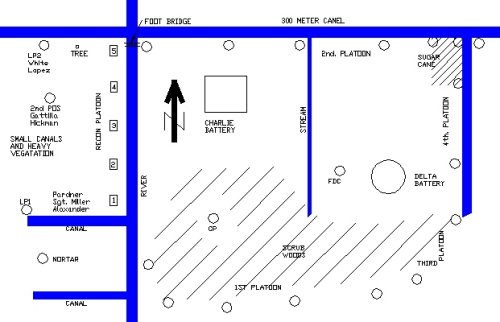
FSB Cudgel
Driving The 15th S3 And Some Questions About A Firefight
By Ron Titus
“The
following is a remembrances that took place sometime between
March
1967 and June 1967 with the 9th Infantry Division, South of Saigon,
in the area of Dong Tam,
In March 1967 I was transferred from
the 175th Engineer Company, 196thLight Infantry Brigade
located in
It wasn’t long after I arrived that I
was instructed to report to Battalion HQ. I was to pick up the S-3 for
transportation by jeep down into the Delta to review work progress by the units
of the 15th CEB. It is my belief that the S-3 at that time was Major
Bill Anderson. Major Anderson was a man of few words for the time I knew him.
Most of our conversation was in the form of directions to our stops, as I had no
idea where the hell I was or were I was going. I did however find that he
(The
Major,) was
a
We would start out from Bear Cat, early
morning and travel unescorted through
I believe it was sometime in May when
we pulled off a fairly large paved roadway into a compound somewhere in the area
of Dong Tam. It was a small compound of congested trees and buildings; half of
the buildings were of Vietnamese architecture with some army additions. As we
pulled into the compound, I could see large bunkers about 25 yards apart, but
only, in some cases, 15 yards from the perimeter wire. There wasn’t much to
that wire to speak of, either. There were civilian buildings on three sides,
outside the wire, less than 50 feet from it. This was scary to me; one could hit
us throwing rocks from those buildings. The backside of the compound had a view
open to rice fields and tree lines with a small dirt road. It was good open area
here, not easy for someone to sneak up on you on this side. I remember there was
also a Vietcong flag way out in the middle of one of these rice paddies. The
guys said it was probably booby-trapped and no one wanted to go near it. There
were infantry in the compound bunkers and about the area, but of what outfits I
do not remember. There were approximately 2 to 3 platoons there. I remember I
didn’t like the cramped area between civilian buildings. I thought, sleeping
under the jeep that night might be in order.
We pulled up to a building that had a
screened in front porch. It reminded me of a summer home, in front of a lake
somewhere back in the states. There were lots of trees and bushes about the
area. It was cool and shady. Sitting in front of the place were two jeeps, not
sandbagged
up and crusted with mud, as my jeep was, but all clean and shinny. There was a
Spec. 5, with a rag, polishing up one of the jeeps when we pulled up. My first
thought was, what a waste of time! The Major jumped out of the jeep with his
usual, “be here in the morning,” grabbed his bags and went into the
building. I introduced my self to the Spec 5 and struck up a conversation.
Seems the Spec 5’s name was Robin
Robertson. He was a driver/orderly for a General who was inside the building,
henceforth the shinny jeeps. I asked him, “How did you get a job driving a
General around?” He said in his case he got shot up a couple of times and they
felt sorry for him and gave him the job. Don’t know if I believed it or not,
but it sounded good to me. Robin said he didn’t like the duty with the General
to much. He didn’t like that he had to shine General’s shoes, lay out his
cloths and the such, but it kept him out of the shit.
Robin said he was drafted by a minor
league pro baseball team before he got drafted and looked forward to playing pro
baseball when he go out of the Army. I often wondered if he made it. Eventually
his name was called and he retreated to the building and I moved on about the
compound looking for food and a place to sleep. I usually ended up in my jeep
under a poncho and tonight was to be no exception.
I
guess it was sometime around 3 or 4 in the morning that I became aware of men
running around the area and of gunfire off in the distance. I could hear
artillery fire going out and striking in the distance. There was a lot of radio
traffic echoing throughout the compound area…. Grabbing my gear I went over to
a group gathered around a radio. The sky was starting to light up out in the
distance above the tree lines. There were aerial flairs and the distinctive
drown of a “Puff” off in the distance. I would guess the activity was about
5 miles out from where we were. On the radio I could hear someone calling for
artillery fire. He was getting it from two different locations. “Shot over!”
“ Shot over!”
with adjustments, I could hear him yelling. This man’s position was
being over run with enemy and he was losing control. I could hear someone
telling him an air strike was evident!
We could hear the jets coming in from our left to right. Someone was
yelling for a flair marker at the same time, FDC (Fire Direction Control) was
calling for verification of hits at the same time. The soldier on the radio was
starting to come apart. He had become highly agitated and was screaming under
the pressure that was consuming him. That’s when the General identified
himself to this solider on the radio told him to calm down; “help is on the
way, you are doing good.” The General asked the person directing the fire to
identify himself.
He said he was the radio operator for his CO. The General asked where his
The
next morning I saw Robin Robertson. I asked him if he knew what happed earlier
that morning? He said that a Company of our Infantry had set up an ambush along
the bank of a river not far from where we were. An estimated Battalion of VC
wandered into it. The CO of the company had been killed in the initial contact
followed by the FO from the artillery. The Spec 4 radio operator for the
A short time later the Major showed up
with a direction to Dong Tam. I asked the Major if he knew anything about the
night’s action. That question got me that familiar stare and a direction to
move on out. I often think of that night and what happened to those involved. I
thought often of Robin Robertson looking for him in the pros from time to time,
but I guess it wasn’t to be…….
Submitted
RT,
15th Eng Bn., E Company, 9th Infantry Div.
by John Mayo
In
2009 my Brother called from Iraq. We were in special session at the time.
“John, I want you to do me a favor. I want you to meet Barbara in
Atlanta and accompany her on a trip.”
“Hot
dang,” I thought, “I am going to Iraq or someplace like that.” I
said, “Sure. Where to?” “Vietnam.” was his one word reply and after I
finished bouncing off the walls, I asked, “When?”
Three
weeks later I was telling Barbara as the Korean Airlines jet was about to touch
down at Tan Son Nhat, “I left this country from this airport 42 years ago.
It’s going to be unbearably hot, smelly, and body pressing body waiting in
line to get out.”
Was
I stunned.
Ho
Chi Minh International Airport was and is a modern marvel. Name the store
and you can buy any high end piece of jewelry or fashion in the airport.
Cool inside, efficient, they could not get you out of the airport fast enough.
Very little…”no”…no checking of incoming baggage, just a passport and
visa check and you’re out the door.
This
is not the Vietnam Mike and I left some for decades ago. We arrived about
11:00 p.m. Vietnam time. We were picked up by our guide which Mike had
arranged earlier, checked into our hotel, and seated on the roof of the Rex
hotel, we began enjoying the night lights of what was back then Saigon, a very
different city under constant siege. The Rex and Continental hotels, the
quarters for many U.S. troops, were both bombed by the Viet Cong during the war.
They
are now modern, four star hotels where everyone, including the maintenance
personnel speaks English. In fact, everyone in the country, including
kindergarten children, seemed to converse with us in English.
I
write this because of something Mike said a couple weeks ago. Mike was a
colonel in the First Gulf War---Desert Storm. He retired a General.
He has been in Iraq most of the time since the second Gulf War, Operation Iraqi
Freedom, as a civilian. At the height of the war some 50,000 people were
working for him. He returned home for a visit last month and stopped by
Clarksdale to visit with his older Brother.
Mike
and I got into a discussion. He knows how I feel about the war and I know
his. We have agreed to disagree. Vietnam came up as we reminisced about
our visit and just how much the country changed in 40 years and how surprised we
were about the impact the American soldier had on the Vietnamese at that time.
When
we returned from there, I wrote a column. This sentence was in that essay:
“This
trip exceeded my expectations of what we accomplished in Vietnam. I
believe then and believe now, that when the American soldier took a “pause for
the cause” to reach out and touch an individual Vietnamese, by God and all
things righteous, 40 years later we “won” the cause.”
I
added a line Mike said on our way to the airport as we were leaving,
“We
will win Vietnam in this generation (2009) because of the way the people were
treated by the American Soldier 40 years ago. Those kids (now the adults we met)
have not forgotten and they will want their children to live better.”
During
our visit, our guide made the same remark when he said, “I hope one day my son
can go to America. We see you as a great country and many of our people
would like to have what you have.”
Then
we began talking about Iraq and Afghanistan. For the most part and for
once, I kept my mouth shut.
“John,
we will win in Iraq for the same reasons. You should see how the children
respond to the American soldier. Like Vietnam, when they grow up, they
will not forget us. The American soldier is the best thing the United
States has going for it.”
I
said to myself and then aloud to him, “I hope you are right, Mike. I
hope so.”
Mike
still serves his country. I am proud of him.
When
he OR SHE takes a pause for the cause, the American Soldier will get it right.
We will have to wait and see. I hope he is right.
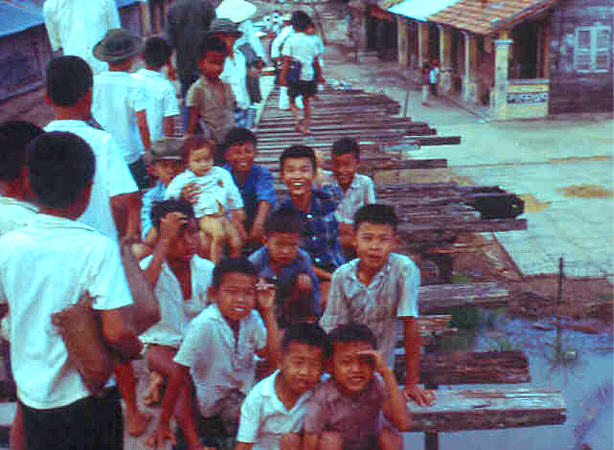
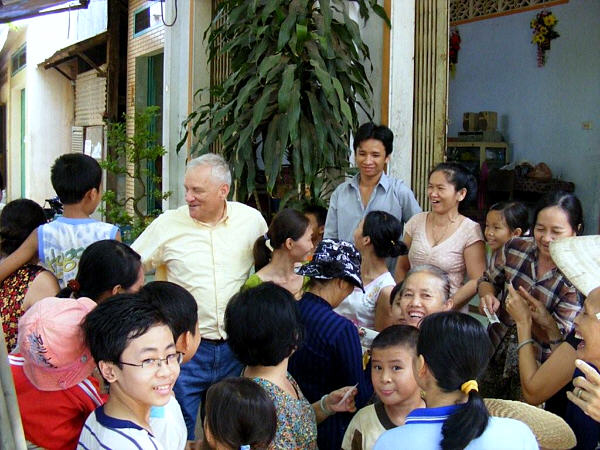
Photo on left 1967 “townspeople” are those same people taken in the same village more than 40 years later.