
Society of the 9th
Infantry Division
-SONID-
9th Infantry Division
History
Webmaster's Note: Many of the Figures shown below are repeated as text to make sure all viewers, regardless of their browser, will be able to view the information.
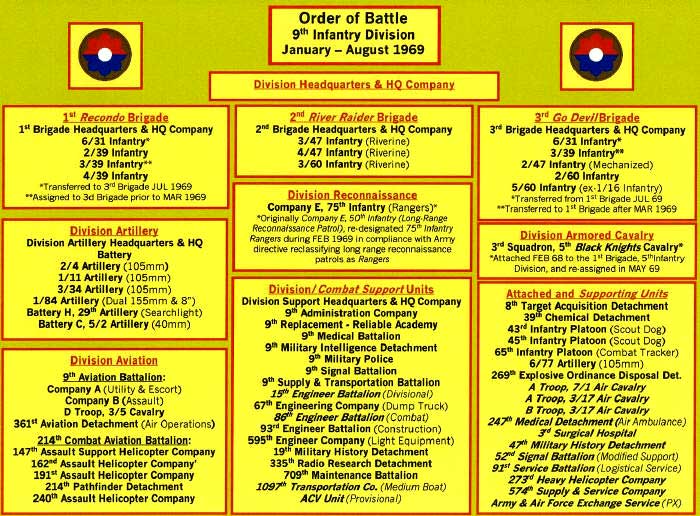
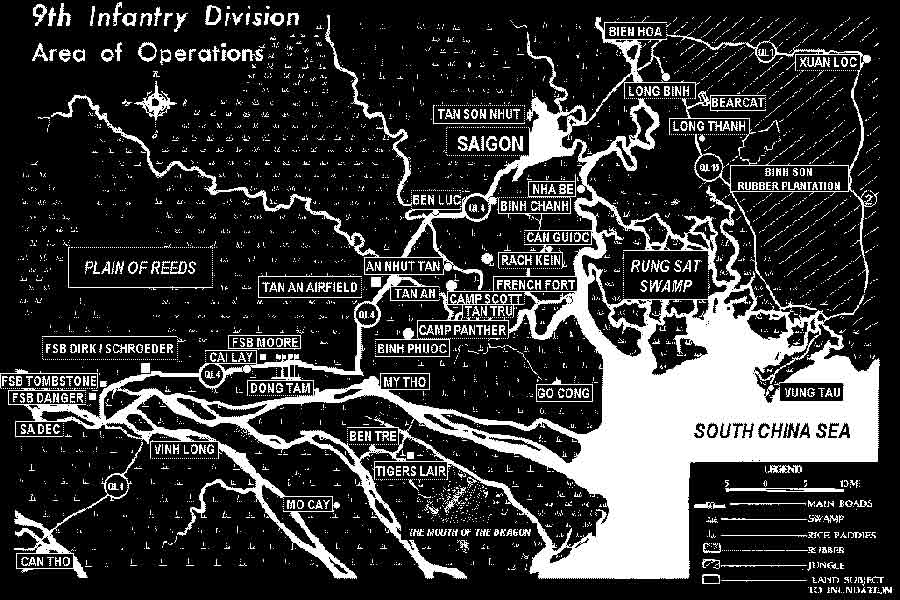
Click to view
Courtesy of Robert Fisher. To view additional
information and photos go to his web site Back
In The Delta
(The above items are large and may take over a minute to completely load over a
56k modem)
LEFT: Listing of units assigned to or working with the 9th Infantry Division -
January-July 1969
RIGHT: Map of the 9th Infantry Division Area of Operation - January-July 1969
A Brief History of the 9th Infantry
Division
(Copyright: Karl Lowe, 2003)
Courtesy of:
Index
(Scroll down and read
the entire document below or select from the Index below and use your BACK
BUTTON to return here)
World
War I (1918-1919)
1923-1940
World
War II & European Occupation (1940-1947)
1957-1962
Vietnam (1966-1970)
1972-1982
1982-1991
9th ID Campaign Credits
9th
ID Decorations (shown only to Brigade level)
Medals of Honor
9th
Infantry Division Duty Stations
9th ID Temporary Wartime
Attached Units
The 9th Division was organized on July 5, 1918 at Camp Sheridan (Montgomery), Alabama.[1] The 45th and 46th Infantry Regiments, formed a year earlier at Ft Benjamin Harrison, Indiana, were the first units to join the division, providing cadre for the 67th and 68th Infantry Regiments, respectively, to give the division it’s authorized “square” configuration. The division soon blossomed as a plethora of support units were added. At full strength (Figure 1), the division would total around 24,000 men. The 9th expected to go to France when it reached full strength, but the war ended before it could get into the fight. No longer needed, it was partially demobilized at Cp Sheridan on February 15, 1919 and Cp Sheridan was closed. The 18th Infantry Brigade’s Headquarters Company and the 45th and 46th Infantry Regiments moved to other posts.[2]
Figure
1
9th Division (1918-1919)
Special
Troops
Division Trains
9th Field Artillery Brigade
HQ Company
HQ & MP
Company
HQ Battery
Field Signal Battalion
Supply Train
25th
FA Regiment (75mm)
Engineer Regiment
Ammunition Train
26th
FA Regiment (75mm)
Heavy Machinegun Battalion
Engineer Train
27th FA Regiment (155mm)
Sanitary Train
9th Trench Mortar Battery
2 Ambulance Companies
2 Field
Hospitals
17th
Infantry Brigade
18th Infantry Brigade
HQ Company
HQ
Company
45th Infantry Regiment
46th
Infantry Regiment
67th Infantry Regiment
68th Infantry
Regiment
25th Machinegun Battalion
26th
Machinegun Battalion
The 18th Infantry Brigade remained active throughout the interwar years, carrying on the 9th Division’s lineage. In 1921, its headquarters moved to Ft Warren (Boston), Massachusetts. Its components were stationed at small posts all over New England.[3] Assigned to I Corps, the brigade’s primary mission was training units of the Reserve Officer Training Corps, the National Guard, and the Organized Reserve Corps in New England. In the 1930s, it also gained responsibility for running Works Progress Administration and Civilian Conservation Corps camps in New England. Because it was recruited where Ivy League colleges were the center of attention, the 18th Brigade began referring to itself as “The Varsity”. The name was allegedly adopted after the brigade’s rough and tumble football team beat Harvard in a 1927 exhibition game in Boston. The name stuck well into the 1940s.
[1]
The site is now Gunter Air Force Base, home of the Air Force NCO Academy.
[2]
The 45th and 46th Infantry were reassigned elsewhere in
1918. The 45th was
reduced to just its officer cadre and deployed to the Philippines in 1921 to
become a Philippine Scout unit. It
distinguished itself at Bataan in 1942. The
46th moved to Cp Travis, Texas and was inactivated there in 1921.
Neither regiment served with the 9th Division again.
[3]
The 5th Infantry Regiment was stationed at Ft Williams, Ft McKinley,
and Ft Preble near Portland, Maine; the 13th Infantry Regiment was at
Ft Strong and Ft Andrews on islands near Boston and at Ft Adams, in Newport,
Rhode Island. The 9th Tank Company was subsequently formed at Ft
Devens, near Ayer, Massachusetts and the 2d Battalion 25th FA was
formed at Madison, Barracks, in upstate New York to give the brigade a fire
support component.
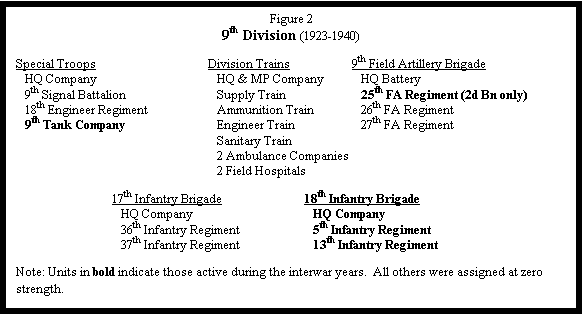 The 9th was restored to the rolls in
1923 (Figure 2), but it was a division only on paper, with most units assigned
at zero strength. The 18th
Infantry Brigade remained its only active component. When shoulder patches were made official throughout the Army
that year, the 9th Division adopted the “octofoil”, which its
soldiers have worn ever since.[4]
The octofoil is a 15th Century device denoting the ninth
brother, a disc centered in a ring of eight foils (points), denoting the
center’s protective older brothers. The
red foils on top symbolize the division’s artillery, the blue foils symbolize
the division’s infantry foundation, the white disc in the center completes the
national colors, and the olive drab background was color of the Army’s
uniform.
The 9th was restored to the rolls in
1923 (Figure 2), but it was a division only on paper, with most units assigned
at zero strength. The 18th
Infantry Brigade remained its only active component. When shoulder patches were made official throughout the Army
that year, the 9th Division adopted the “octofoil”, which its
soldiers have worn ever since.[4]
The octofoil is a 15th Century device denoting the ninth
brother, a disc centered in a ring of eight foils (points), denoting the
center’s protective older brothers. The
red foils on top symbolize the division’s artillery, the blue foils symbolize
the division’s infantry foundation, the white disc in the center completes the
national colors, and the olive drab background was color of the Army’s
uniform.
In October
1939, the 18th Infantry Brigade deployed to Panama to help protect
the Canal. There were fears in
Washington that Germany or Japan might try to grab the strategic waterway or
seek to destroy it with a commando raid. In
its new assignment, the brigade had to tear off its octofoil shoulder patches
and sew on the Panama Defense Command’s insignia.
For the first time since 1918 there was no longer an active component of
the 9th Division.
[4]
The division’s earlier unofficial shoulder patch, adopted at Cp Sheridan, was
a shield with its top half red, bottom half blue, and a gold “9” in the
center.
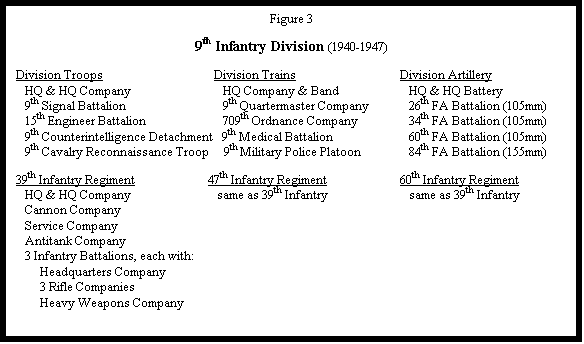 On August 1, 1940, the 9th Division was
reactivated at Ft Bragg, North Carolina.[5]
In contrast to its cumbersome World War I “square” configuration, the
new 9th was organized as a streamlined “triangular” division,
organized as shown in Figure 3. Only
the 26th Field Artillery could claim a historical link to the
original 9th Division formed in 1918.
On August 1, 1940, the 9th Division was
reactivated at Ft Bragg, North Carolina.[5]
In contrast to its cumbersome World War I “square” configuration, the
new 9th was organized as a streamlined “triangular” division,
organized as shown in Figure 3. Only
the 26th Field Artillery could claim a historical link to the
original 9th Division formed in 1918.
The division underwent eight months of individual and unit training and a month-long division-scale exercise. The “Varsity” completed its graduation exercise at Ft Bragg in April 1941 and became combat ready. In October and November of that year, the division participated in the Carolina Maneuvers, followed by amphibious training on North Carolina’s outer banks, a chain of barrier islands along the Atlantic coast.
[5]
The 36th and 37th Infantry Regiments were concurrently
relieved from assignment without having seen a day of active service with the
division. The 18th
Brigade in Panama was also relieved from assignment.
[6]
France held a deep grudge against Britain, America’s partner in the North
Africa landings, because Britain had bombed the French fleet at Mers el-Kbir,
Algeria in 1940 to keep it from falling into German hands after France
surrendered.
The 9th did not initially operate as a division in North Africa. Its 39th Infantry Regimental Combat Team (RCT)[7] landed in Algeria under the Eastern Task Force, while the 47th and 60th RCTs landed in French Morocco under the Western Task Force. The 47th RCT took the Moroccan port of Safi, allowing elements of the 2d Armored Division to land unopposed and attack toward Casablanca. The 60th RCT landed near the French garrison city of Port Lyautey, Morocco where it encountered tougher resistance. Aided by naval gunfire, the 60th RCT took the nearby airfield on the first day, but it took two more days of hard fighting to take the city. French resistance ceased on November 11, a date laden with irony since it was the anniversary of World War I’s end. Troops that had just fought bitterly against Americans and the British, suddenly became allies against the Germans. Trust would take longer to develop.
When the
Germans were driven from Libya into Tunisia by the British Eighth Army in
February 1943, the 9th Division moved over a thousand miles from the
border of Spanish Morocco to join the fighting.
Its 60th RCT was attached to the 1st Armored
Division on March 12 and took the important road junction of Sened Station nine
days later. The 9th
Infantry Division fought as an entity for the first time on March 28, 1943.
Attacking from positions abandoned earlier by the 1st Infantry
Division, it tried to open a path for the 1st Armored Division, but
was repulsed with heavy losses. A similar attempt to isolate and capture Hill 772, which
dominated the area, also met with failure.
Finally, in a corps-level effort alongside the 1st Infantry
Division, the 9th broke through German lines and established contact
with advanced patrols of the British Eighth Army.
On April 11,
the 9th relieved the British 46th Infantry Division in
northern Tunisia. Reinforced by the
French Corps d’Afrique, the 9th
attacked along the Sedjenane Valley toward the port of Bizerte, through which
German and Italian troops were trying to escape across the Mediterranean to
Sicily. The attack began from a
string of hills west of Sedjenane on April 23 and ended on May 8 when the 47th
RCT and the Corps d’ Afrique entered
Bizerte. The war in North
Africa ended five days later when remnants of the Italian First Army surrendered
to British forces near Tunis.
For the 9th
Infantry Division, the war in the Mediterranean was still not over.
The division landed at Licata, Sicily on September 15, 1943, five days
after the initial allied landings to enter combat in northern Sicily on July 23.
Pushing itself to near exhaustion across a long string of hills just
north of Mount Etna, the 9th Division outflanked the German 15th
Panzer Grenadier Division, rendering its foe’s carefully-prepared defenses
useless. Its unexpected speed
forced the Germans to evacuate Troina where they had held up the 1st
Infantry Division for days. The 9th
then raced the US 1st and 3d Infantry Divisions and the British 78th
Division toward the port of Messina where the Germans and Italians were
struggling to evacuate their remaining forces across the Straits of Calabria to
Italy. After running out of
passable roads in its sector, the 9th’s attack ended, but it had
done its job admirably. By October
17, the battle for Sicily was over.
[7]
A regimental combat team was formed around an infantry regiment (3 infantry
battalions), reinforced by a field artillery battalion, a combat engineer
company, and sometimes a tank battalion or tank destroyer battalion.
After its
well-executed offensive in northern Tunisia and its lightning dash across
northern Sicily, the 9th was becoming known as one of the Army’s
most reliable divisions. Because of
its performance, it was among the divisions selected for redeployment to England
in preparation for the coming invasion of Europe.
It left Sicily on November 8, 1943, exactly a year after landing in North
Africa, and reached England on November 25.
In England, the 9th was assigned to the US First Army and began preparing for the coming invasion of France. After six months in England, it landed on France’s Normandy coast on June 10, 1944. Following the path of the 4th Infantry Division, the 9th crossed Utah Beach and took the German gun positions dominating the beach head. The 39th RCT, spearheading the attack, earned its nickname “anything, anywhere, any time--bar none” in hard fighting against German units that had held up the 82d Airborne and 4th Infantry Divisions for nearly a week.
After a brief rest, the 9th crossed the Seine River on August 27, driving north toward the Belgian border. Belgium’s liberation began when a patrol of the 9th Reconnaissance Troop crossed the border near Charleroi at 1107 on September 2, 1944. For the next 12 days, the division pushed across southern Belgium to the frontiers of Germany, crossing the border through an array of concrete barriers and bunkers with interlocking fire known as the Siegfried line. It took five more days of hard fighting, but the 9th got through, exposing the southern approaches to the city of Aachen, the first German city to fall to the allies. The 1st Infantry Division would have the honor of taking Aachen, but it was the 9th that opened the door.
On December 22, 1944, a platoon of E Company 39th Infantry, led by Technical Sergeant Peter J. Dellesondro, held a road junction under attack by a battalion of German paratroopers. Their attack followed right on the heels of a nerve-shattering mortar and artillery concentration. Dellesondro’s men, expecting their position to be overrun, began to abandon their positions under heavy fire but he managed to keep the platoon together by moving constantly up and down the line, shouting and shoving or dragging his terrified men back to their foxholes. He worked his way to an exposed observation point to direct mortar fire against the Germans nearing his line. His accurately placed fire stopped the Germans initially, but when the mortar fire lifted, they resumed their attack, concentrating their fire against Dellesondro’s prominent position. When his rifle ran out of ammunition, he crawled 30 yards across open ground to reach a machinegun, which he fired until it jammed. After clearing a jammed cartridge from the gun’s chamber, he fired another short burst to keep four Germans from killing one of his medics who was trying to give first aid to two wounded soldiers in a foxhole. Again the gun jammed and became useless. When his platoon was surrounded, he threw hand grenades until he ran out and then called in mortar fire on his own position, buying time for his company to block a further German advance. He was captured but survived to be presented the Medal of Honor after the war.
[8]
Sheridan Kaserne, in Augsburg, Germany was named after him during
Germany’s subsequent occupation. Nelson
Barracks at Neu Ulm was named after another of the 9th Division’s
Medal of Honor winners, William L. Nelson of the 60th Infantry
Regiment.
Because all bridges across the Rhine had been blown but one, the First Army pressed its attack to capture the remaining bridge before the job got any harder. Arriving just behind the 9th Armored Division, which captured the Ludendorff Bridge on March 7, the 9th Infantry Division surged across to widen the bridgehead. For six days, it held the contested east bank of the Rhine, taking command of a small corps as an array of units from other divisions and corps troops crossed the river under the direction of the division’s 9th MP Company. MPs steadfastly stood at their posts on the bridge without protection from steady German shellfire and air attacks. When one MP went down, another took his place. MPs forced drivers who tried to abandon their vehicles on the bridge during an air attack, to get back in their vehicles and continue driving. In more than one case they had to do so at gunpoint, but they kept the convoys rolling.
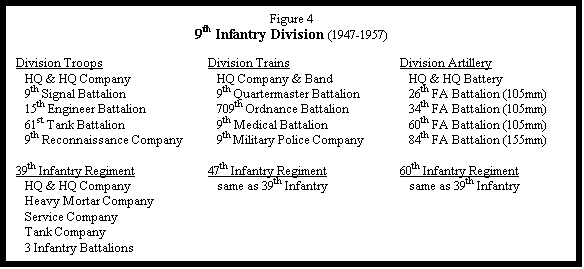 The “Old Reliables” remained inactive for only
six months. It was reactivated at
Ft Dix, New Jersey on July 15, 1947. Ft
Dix was the division’s last stateside post before being shipped off to North
Africa in 1942 and its first post when it returned. Organized at cadre strength (Figure 4), the division’s
mission was to conduct basic and advanced individual training for soldiers
recruited in the northeastern states. On
May 25, 1954, the 69th Infantry Division assumed the training mission
at Ft Dix and the 9th Division’s colors were sent to Germany,
replacing the Pennsylvania National Guard’s 28th Infantry Division,
which had relieved the 9th in the Huertgen Forest nearly a decade
earlier.
The “Old Reliables” remained inactive for only
six months. It was reactivated at
Ft Dix, New Jersey on July 15, 1947. Ft
Dix was the division’s last stateside post before being shipped off to North
Africa in 1942 and its first post when it returned. Organized at cadre strength (Figure 4), the division’s
mission was to conduct basic and advanced individual training for soldiers
recruited in the northeastern states. On
May 25, 1954, the 69th Infantry Division assumed the training mission
at Ft Dix and the 9th Division’s colors were sent to Germany,
replacing the Pennsylvania National Guard’s 28th Infantry Division,
which had relieved the 9th in the Huertgen Forest nearly a decade
earlier.
[9]
They were Herschell F. Briles (899th
Tank Destroyer Battalion), Peter J.
Dellesondro (39th Infantry), William
L. Nelson (60th Infantry), Carl
V. Sheridan (47th Infantry), and Matt Urban (60th Infantry). Briles’, Nelson’s, and Sheridan’s medals were presented
posthumously.
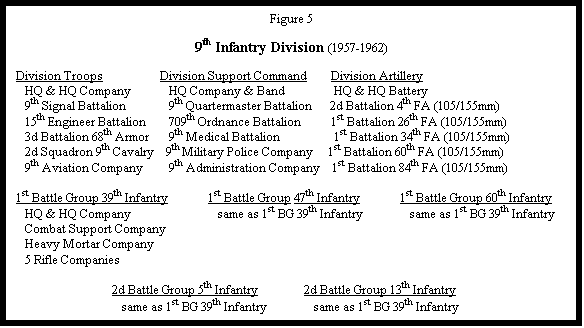
In August 1956, the 9th rotated to Ft Carson, Colorado under Operation Gyroscope. The following year, it was reorganized under the “Pentomic” concept (Figure 5). The reconfigured 9th Infantry Division remained at Ft Carson until its inactivation on January 31, 1962.
For the next four years, the division’s colors remained furled, but when war came again, “the Old Reliables” returned to active service. The division was reactivated at Ft Riley, Kansas on February 1, 1966. On December 19, 1966, Major General George S. Eckhardt led the division ashore across the beach at Vung Tau, Vietnam. He was met by General William C. Westmoreland, who had commanded an artillery battalion with the division in World War II and later became the division’s Chief of Staff and Commander of the 60th Infantry Regiment during the occupation of Germany.
The division
would operate initially from Bearcat Base (Camp Martin Cox), east of Saigon.
Its area of operations had been owned by the Viet Cong (VC) and their
Viet Minh[10]
predecessors since the early in the war of liberation against the French.
For the next four years, the octofoil shoulder patch would become a
familiar sight around Saigon and along the labyrinth of waterways lacing the
upper Mekong River Delta. The
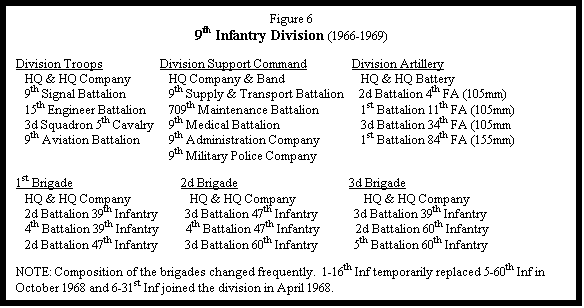
division’s organization (Figure 6) reflected its unique mission.
The 1st and 3d Brigades each had two standard infantry
battalions and a mechanized infantry battalion, while the 2d Brigade, with three
standard infantry battalions, was organized for riverine operations, living and
operating from ships and river patrol boats operated by the US Navy’s Task
Force 117.
[10]
The terms Viet Minh and Viet
Cong derive from “Viet Nam Duc Lap
Dong Minh Hoi” (Independence Party), Vietnam’s Communist (Cong
San) Party.
The division’s first combat operation of the war was Operation Colby, initiated on January 20, 1967 to drive the VC out of an area called the “Phuoc Chi Secret Zone”. While a small operation, Colby heralded the division’s reach into an area of operations that was to expand to 7000 square miles. Soon afterward, 3-5th Cav, the division’s armored cavalry squadron, participated in Operation Junction City, operating northeast of Saigon alongside the 1st and 25th Infantry Divisions and the 196th Light Infantry Brigade.
In March,
elements of the 3d Brigade fanned out across Long An Province, establishing fire
support bases at Tan An (3d Bde HQ and HHB 2-4th FA), Tan Tru (2-60th
Inf), Binh Phuoc (5-60th Inf), and Rach Kien (3-39th Inf).
The brigade’s first big fight occurred when a company of the 3-39th
Infantry was attacked and overrun in its night defensive position at a road
junction 4 km north of Rach Kien. The
brigade responded like a coiled snake the next day, attacking the VC 2d Long An
Battalion in its base area along Doi Ma Creek, west of Rach Kien. The enemy paid with the lives of 209 of its men.
In May, the 2d
Brigade conducted a riverine operation in eastern Long An Province near Ap Bac.
Soon after crossing a deep stream, A Company 3-47th Infantry
ran into intense rifle and machinegun fire and rocket-propelled grenades (RPGs).
Soon every man in the lead squad was dead and several more were killed as
they tried to save their buddies. Most
members of A Company were wounded. Piling
on any unit he could grab, Colonel William B. Fulton, the brigade commander,
threw companies from three battalions into the fight.
By late afternoon, A and B Companies 3-60th, and C Company
5-60th Infantry had reinforced the 3-47th.
The ARVN 1st Battalion 46th Infantry (of the ARVN
25th Division) blocked the enemy’s escape route to the south.[11]
The VC 514th Battalion would soon pay dearly for what it had started.
By 1900, the
counterattack, led by “Bandido Charlie” (C/5-60th Infantry),
surged across the soggy paddies in armored personnel carriers while riflemen
from five other rifle companies closed in on the nearby tree line.
During the ensuing fight, Sergeant Leonard Keller and Specialist Raymond
R. Wright of A Company 3d Battalion 60th Infantry earned the Medal of
Honor for their fierce two-man assault that knocked out a string of bunkers and
a mortar position with rifles and hand grenades and then chased the VC out of an
area where several men had been wounded.
The fighting was hand-to-hand throughout the tree line.
GIs wanted revenge for what had happened to their comrades back at the
creek. One man beat an enemy
soldier to death with his steel helmet after his weapon jammed.
Another stabbed an enemy soldier to death under similar circumstances.
Nightfall brought the fighting to a close as surviving enemy troops
slipped away. In the end, 15
Americans and 181 VC had been killed.
On September
14, it was 3-60th Infantry’s turn to get in trouble.
Moving by river patrol boat, the battalion advanced up the narrow Ba Rai
Creek, a nipa[12]-lined
tributary of the Mekong. It was
followed by 3-47th Infantry, also on boats.
The boats were spaced about 50 feet apart but in places the shore was 15
feet or less from the boat’s sides. Suddenly
at 0730, two RPGs struck the lead boat. Four
more RPGs soon followed, turning it into a floating wreck and killing two of its
crew but its skipper stubbornly kept his boat in action.
Throughout the day, fighting raged all along the canal, with enemy fire
coming from both banks of the creek. Helicopter
gunships, fighters, artillery, and Navy “Black Pony” attack aircraft added
their fires to those of the well-armed patrol boats.
As the fight progressed, elements of four American infantry battalions
piled into the swampy terrain by boat and helicopter to box the enemy in.
Aboard the boats, 7 men had been killed and 123 wounded. As night fell, the enemy was more interested in slipping away
than continuing the fight and by morning the battlefield’s stillness was
broken only by the droning roar of river boats leaving the area.
[11]
This ARVN battalion operated routinely with the US 9th
Division, something the ARVN 25th Division Commander, BG Truong Chinh,
tolerated grudgingly. The author of
this short division history was the battalion’s senior advisor during the
battle.
[12] Nipa is a palm that grows profusely along the banks of
rivers, streams, and canals throughout Southeast Asia.
It grows to a maximum height of only 10 feet, but its thick trunk, dense
growth pattern, and deep roots make it a formidable defensive barrier, used
extensively by the Viet Cong to shelter temporary base areas and weapons caches.
On November 18,
a battalion-size attack on an artillery fire support base near the vital road
junction of Cai Lay sparked another bitter fight. At 0200, enemy mortars were striking at a rate of about 3 per
minute, keeping crews from servicing their weapons. Seeing an enemy platoon forming to attack across an adjacent
stream, PFC Sammy L. Davis, a cannoneer with C Battery, 2d Battalion 4th
FA, grabbed a machinegun and sprayed the enemy to give his fellow crewmen time
to recover and fire their howitzer. An enemy recoilless rifle round struck the
weapon, disabling the entire crew and setting the position on fire.
Although stunned by the blast, Davis ran to the weapon alone, slammed a
shell into the breech, and fired point blank at the enemy assault force.
The unstaked howitzer’s recoil sent Davis sprawling, but he got up and
fired 4 more shells into the oncoming enemy force.
A mortar round struck 20 yards away, wounding Davis, but it did not stop
him. Adrenalin had taken control.
Davis grabbed an air mattress because he could not swim and paddled
across the stream to rescue 3 wounded men stranded at an isolated observation
post. As the men escaped across the
stream, Davis stood and fired his rifle into the tall grass surrounding the OP.
Davis then returned to his gun position aboard the air mattress and joined
another howitzer crew firing on the fleeing enemy.
For his exceptional courage and determination under fire, Davis was
awarded the Medal of Honor.
On January 10,
1968, a daylong fight broke out in Dinh Thuong Province when an airmobile
assault by A Company 3-60th Infantry went sour.
Enemy rifles, machineguns, mortars and RPGs struck the company from three
sides as it landed. Within minutes, 30 men were down. Aidman PFC Clarence E. Sasser disregarded his own safety and
several painful wounds to dash back and forth through the fire to drag men to
the protective cover of a paddy dike. Even
after both legs were immobilized by painful wounds, Sasser continued to crawl
among the wounded to administer life-saving aid.
He continued his unrelenting effort for over five hours under continuing
enemy fire. He was awarded the Medal of Honor.
On January 30,
1968, the people of Vietnam were about to celebrate the lunar New Year, the
country’s most important holiday. Viet
Cong and North Vietnamese Army units had been moving into position around major
South Vietnamese cities for over a month, however, and their support elements
had stockpiled caches of ammunition near important places they were to attack.
The scale, focus, and intensity of the enemy’s attacks on Vietnam’s
cities caught senior officials by surprise.
In the Saigon area, “the Old Reliables” seemed to be everywhere at
once. On the offensive’s first
day, 2-47th Mechanized Infantry and 4-39th Infantry fought
on the city’s northern approaches to protect part of the Army’s sprawling
headquarters and support complex at Long Binh; 3-5th Cavalry fought
at nearby Bien Hoa Air Base; and 5-60th Mechanized Infantry fought on
the city’s west side at the Phu Tho race track.
In the fighting
at Long Binh, the VC had infiltrated and fortified the “widow’s village”,
a complex of shacks adjacent to US II Field Force Headquarters.
The area was inhabited mainly by widows and families of dead ARVN[13]
soldiers. When rockets and mortars began to rain down on II Field Force
Headquarters from the “village” and a nearby wooded draw, 2-47th
Mechanized Infantry was rushed in from the base’s southern perimeter.
Riding into a storm of RPG, mortar, and automatic weapons fire, the
battalion became engaged in a fight it could not win alone.
More infantry would be needed to clear the labyrinth of well-prepared
enemy fortifications. In response,
4-39th Infantry arrived by helicopter, landing in a “hot LZ”, a
term meaning the enemy controlled the landing zone and were firing on the
helicopters as they landed to disgorge troops.
Supported by attack helicopters from Bien Hoa and other nearby bases, the
two battalions launched a coordinated attack to clear the area.
By nightfall, over 200 enemy soldiers lay dead in the shattered ruins of
the “widow’s village” and another 32 were captured. Four Americans died in the action.
At Bien Hoa Air
Base, 3-5th Armored Cavalry rushed onto the eastern end of the
airfield and a nearby wooded area with all guns blazing.
The close-in fighting, like that at Long Binh, raged all day and into the
night. 40 enemy soldiers and 3
members of 3-5th Cavalry had been killed by the time enemy troops
were driven off the airfield. At
the French military cemetery[14]
near the Phu Tho race track, 5-60th Mechanized Infantry encountered
snipers in the trees and a line of hasty earthen bunkers from which the
interlocking fires of a VC battalion protected a rocket and mortar unit located
in the courtyards of nearby buildings. Heavy
fighting continued all day and all night, tapering off into sporadic outbursts
for the next four days as trapped enemy troops tried to fight their way out of
the city. 125 of them died trying.
On the city’s southern edge, elements of the 3d Brigade retook Cholon
District and fought their way up the city’s east side along the Saigon River.
In Kien Hoa
Province at edge of the Mekong Delta, an enemy battalion overran the provincial
capital of Ben Tre, driving government officials and advisors into a walled
compound in the city’s center. Their
desperate call for help brought 3-39th Infantry into the center of
town in a daring air assault while 2-60th Infantry fought
house-to-house from the city’s east side and 2-39th Infantry fought
its way in from the southwest. Two
battalions of the ARVN 7th Division closed in from the north, their
American advisors coordinating their fires and maneuver with adjacent US units.
160 enemy troops and 11 Americans died in fighting that lasted three days and
left Ben Tre utterly destroyed. It
was not a satisfying victory.
3-5th
Armored Cavalry was again in action on 2-3 February, 1968 when the Viet Cong
besieged a police station and provincial government compound at Xuan Loc,
northeast of Saigon. Enemy RPGs and
automatic weapons fire lashed out from both sides of the city’s main street as
3-5th Cavalry charged in on armored personnel carriers, but the
cavalrymen were able to rescue the trapped policemen and helped the ARVN 18th
Division secure the government complex. The
fighting did not end there, but continued for two more days in a nearby rubber
plantation.
At My Tho, the
capital of Dinh Thuong Province and one of the Delta’s largest cities,
infantrymen of the Mobile Riverine Force stormed ashore to help the ARVN 7th
Division retake the city. The Viet
Cong 261st, 263d, and 514th Main Force Battalions fought
hard to hold onto the city but were driven out by determined “Old Reliables”
of the 3-47th and 3-60th Infantry blasting their way
through walls and down alleyways to break up the enemy’s cohesion.
To care for civilian casualties, Lieutenant Colonel Travis Blackwell, the
9th Division Surgeon, flew into the city’s center with a surgical
team to help man the city hospital’s four operating suites.
Because the hospital was too crowded, Blackwell established an operating
area in a protected street where he performed 35 operations on the battle’s
first day alone. Under fire for
three days, Army doctors and nurses took care of the injured around the clock
with no time to rest.
By February 4,
the ARVN 21st Division had lost control of the important delta city
of Vinh Long where the VC 306th and 857th Battalions had
been on the offensive since the night of January 31. Troops of the 2d Brigade were rushed by boats and
helicopters from the fighting at My Tho to help retake Vinh Long. After driving the VC out of the city on February 5,
infantrymen of the 2d Brigade, backed by Navy “monitor” river boats and Army
attack helicopters, pursued the retreating enemy along the nipa-lined Ba Moi
canal. In its attempt to cover the
withdrawal of the 306th Main Force Battalion, the VC 857th
Local Force Battalion was nearly destroyed.
The following
day, B Company 3-60th Infantry was ambushed aboard river boats
patrolling a stream thought to be one of the VC escape routes from Vinh Long.
As riflemen struggled through the dense nipa growth to drive the
ambushers out, an 8-man squad of B Company was cut off under heavy fire.
When an enemy hand grenade landed in the squad’s midst, PFC Thomas J.
Kinsman threw himself on the grenade to save his comrades.
Although severely wounded in the head and chest, Kinsman miraculously
survived the blast. For his act of
selflessness, he was awarded the Medal of Honor.
On an operation
south of Saigon on March 17, 1968, B Company 4-39th Inf encountered
heavy fire from enemy bunkers dug into a nipa-lined stream.
One man was killed and 3 were wounded in the initial outburst of fire.
Specialist Edward A DeVore, Jr rushed forward to cover the evacuation of
the wounded with his machinegun. Recognizing
the wounded men’s situation was nearly hopeless unless someone could quell the
enemy fire, he assaulted the enemy position, firing his machinegun from the hip
as he rushed forward across open ground. Hit
in the shoulder and knocked off his feet just 35 meters from the enemy, DeVore
got back up and continued firing, drawing all enemy fire unto himself as his
comrades evacuated the three wounded men.
He was killed just moments later. For
his selfless act of extraordinary valor, he was awarded the Medal of Honor.
On May 7, 1968,
the VC made a second attempt to take Saigon, although a weaker attempt than the
Tet Offensive in February. Enemy
action was centered on the predominantly Chinese district of Cholon at the
city’s southeastern edge. After
taking the Y Bridge over the Kinh Doi Canal, a VC/NVA regiment established
itself in houses overlooking the bridge and adjacent areas along the canal.
2-47th Mechanized Infantry, reinforced by the newly-arrived B
Company 6-31st Infantry[15],
retook one side of the bridge and drove the enemy into a cement factory where an
ARVN Ranger Battalion scaled the surrounding walls and fought its way into the
center with support from US helicopter gunships. Meanwhile, south of the city, 3-39th Infantry and
ARVN 3d Battalion 46th Infantry turned back an attempt to reinforce
the VC unit trapped in Cholon. Along
the Kinh Doi Canal defining the city’s southern edge, the rest of the 6-31st
Infantry landed by helicopter under intense fire. Firing into houses lining the canal, the battalion turned
west along the perimeter road to secure two smaller bridges across which the
enemy might try to escape.
At 6:00 the
next morning, the 6-31st Infantry responded to an enemy attack on an
ARVN Regional Force outpost at the city’s edge while 3-39th
Infantry entered an adjacent part of the city where the enemy had prepared hasty
bunkers to block alleyways the night before.
The fighting raged until 7:30 that evening. Supported by artillery, attack helicopters, and 2-47th
Infantry’s APCs, companies from the 3 US battalions and ARVN troops drove the
enemy out block by block in some of the war’s most desperate fighting.
Knowing they could not escape, the VC fought like cornered rats.
Over 1000 of them died, as did 50 members of the 9th Division
and an unknown number of ARVN troops. Civilian
casualties in Cholon are also unknown, but must have numbered several thousand
dead and wounded.
On May 14,
1968, 3 VC were ambushed by a rifle squad of the 4-47th Infantry in
Kien Hoa Province. Two of the VC
were killed instantly, but a third threw a grenade at the squad to cover his
escape. PFC James W. Fous leaped on
the grenade to save his comrades. He
was awarded the Medal of Honor for sacrificing his own life to save others.
On June 1,
1968, the action shifted to the Plain of Reeds, a watery grassland forming a
triangle between the Vam Co Tay (Oriental) and Vam Co Dong (Occidental) Rivers
and the Cambodian border. The VC
and NVA used the area as an infiltration corridor and established rest and
resupply camps along the wooded riverbanks and several canals built by the
French to allow the area to be inhabited—it never was.
There enemy units were trying to regroup after the disasters that befell
them during the Tet Offensive. C
Company 2-39th Infantry was the first unit to air assault into the
vicinity of a suspected base camp. The
VC let the helicopters land, disembark the troops, and depart before they
struck. As the UH-1H “Hueys”
and AH-G “Cobra” gunships departed, the VC cut loose with everything they
had from a complex of bunkers concealed in bramble thickets and grass that was
up to 8 feet tall in places. Enemy
fire came from so close that there was no possibility of engaging the enemy with
artillery and helicopter gunships. The
best C Company could do is hug the earth in the tall grass, and hope the enemy
fire would pass harmlessly over their heads.
Many were not so lucky, cut down in the opening fusillade of fire.
A Company 2-39th
Infantry and two companies of 2-60th Infantry were lifted into the
area to relieve the pressure on C/2-39th. Each of the companies ran into more bunkers, precipitating a
succession of hot firefights at close range.
Where feasible, artillery and Cobra gunships from 7-1st Air
Cavalry were brought in to pound the area.
Despite the odds, the enemy slipped away during the night.
A sweep of the area in the morning revealed upward of 300 bunkers, 41
enemy dead, numerous weapons, and blood trails through the grass to the south.
To keep the pressure on Colonel Henry E. Emerson, the 1st
Brigade’s Commander, airlifted A Company 2-39th Infantry into an
area along a wooded canal where he suspected the enemy might have fled.
He was right. As A Company moved toward the treeline, it came under heavy
fire, killing its commander and several others.
Air strikes, gunships, and artillery pounded the area while Emerson
landed company after company into the surrounding area to box the enemy in.
A, B, and C Companies 2-60th Infantry, A and C Companies 2-39th
Infantry, and C Company 4-47th Infantry were inserted to form a tight
perimeter. A border ranger unit from Duc Hue Special Forces Camp covered
the canal’s opposite bank. In 4
days of hard fighting, 228 enemy soldiers and 36 Americans were killed.
It had been a lopsided but costly victory for the 1st Brigade.
On December 29,
1968, an ambush patrol sent out by B Company 2-39th Infantry ran into
a VC force on the move. After
routing the enemy, the patrol set up an ambush along a paddy dike, expecting the
enemy to return. They returned just
after midnight, throwing several grenades to mask their location.
One grenade wounded two Americans and a second landed near a cluster of 4
soldiers that included PFC David P. Nash. Instead
of rolling away to safety, Nash shouted a warning and jumped toward the grenade,
intending to throw it back. His
body took the full force of the explosion, killing him instantly, but saving the
lives of his comrades. He was
awarded the Medal of Honor for his selfless act of courage.
On January 6,
1969, A Company 2-39th Infantry again ran into trouble when it ran
into a bunker complex in Kien Phong Province.
Caught in a crossfire, the company became pinned down.
Staff Sergeant Don J. Jenkins grabbed a machinegun from its dead gunner
and crawled forward to try to relieve the pressure.
When the gun jammed, he grabbed a rifle and continued to fire into enemy
bunkers from an exposed position. When
another soldier cleared the machinegun’s stoppage, Jenkins fired the weapon
until it ran out of ammunition. Repeatedly
he crossed open ground to get more ammunition and return to the gun. When he was unable to find more ammunition, he collected two
antitank weapons and fired them into enemy bunkers from a distance of only 20
yards. Although wounded, he then
took up a 40mm grenade launcher and pumped round after round into other bunkers
within his field of vision, relieving the pressure on his sector.
Seeing that 3 wounded men were laying in the open under enemy fire, he
rushed forward again and again, dragging or carrying them to safety.
Jenkins’ inspirational leadership and repeated feats of courage rallied
his platoon and earned him the Medal of Honor.
Between January
and April 1969, the 9th Division was in almost constant combat,
working the paddies, canals, rivers, and swamps of the northern Delta, fertile
Long An Province, and the Plain of Reeds to thwart a third enemy attempt to
attack Saigon. Although exact
results are hard to determine in battles fought mostly in densely foliated
terrain or at night, but it is certain that the VC failed to invade Saigon
again. Estimated enemy casualties
ranged between 8000 and 9000, a disastrous blow to the VC who had already
suffered heavily the year before.
In June 1969,
it was announced that the 9th Infantry Division would be the first
unit withdrawn under President Nixon’s Vietnamization program, turning the war
in the Delta over to ARVN forces who had grown steadily stronger over the years
they had operated alongside the 9th. Elements of the division began departing in July and the
division was officially inactivated at Schofield Barracks, Hawaii on September
25, 1969. When it passed from the
active rolls, the 9th had served in combat on three continents, had
been in battle for nearly seven years, had earned 6 foreign awards, and its
members had earned 15 Medals of Honor (5 in World War II and 10 in Vietnam).
But not all of
the division was included in the inactivation.
As in 1918, part of the division remained active.
The 3d Brigade remained in Long An Province to shield Saigon’s southern
approaches. Its components included
the 6th Battalion 31st Infantry, 2d Battalion (Mechanized)
47th Infantry, 2d Battalion 60th Infantry, 5th
Battalion 60th Infantry, 2d Battalion 4th Field Artillery,
99th Support Battalion, D Troop (Air) 5th Cavalry, E
Company 75th Ranger Infantry, and the 118th Assault
Helicopter Company. The brigade’s
robust organization was also a test of a new separate brigade concept.
Because of the
intense fighting in the 9th’s area of responsibility in 1968 and
1968, things were fairly quiet in the northern Delta and Long An Province in
1970, but there were always an occasional encounter with an enemy squad or
platoon and constant encounters with booby traps to keep the “Go Devils” of
the 3d Brigade on their toes. Elements
of the brigade moved from Long An Province into the pineapple fields of Hau
Nghia Province on Saigon’s western approaches.
Throughout its remaining tour, the 3d Brigde operated under the control
of the US 25th Infantry Division, headquartered at the sprawling Cu
Chi base camp in the northwestern part of Hau Nghia. In April 1970, ARVN troops invaded enemy base areas in
Cambodia that had long been a safe haven for the Viet Cong. The offensive was prompted by a favorable change in
Cambodia’s government and the brutal slaughter of ethnic Vietnamese in several
Cambodian cities.
It was not long
before the 3d Brigade went into action in support of the Vietnamese, but it
would not fight as a brigade. 2-47th
Mechanized Infantry and 5-60th Infantry were detached to the 1st
Cavalry Division, which crossed the border from Tay Ninh Province to invade a
huge base area near the Snuol Rubber Plantation. 2-60th Infantry was detached to the US 25th
Infantry Division in its drive along the long-closed Highway 1 linking the
Cambodian capital of Phnom Penh with Saigon.
Only 6-31st Infantry remained under 3d Brigade control,
attacking across the Plain of Reeds to seize the Ba Thu base area and pursue
retreating enemy units toward the Cambodian Provincial capital of Svay Rieng.
In a series of sharp firefights in and around towns with nearly
unpronounceable names, the “Polar Bears”[16]
of the 6-31st acquitted themselves well, pushing to within a few
miles of Svay Rieng before President Nixon announced for political reasons that
no American troops would advance more than 21.7 miles into Cambodia.
We were already at the limit and in some cases just beyond.[17]
[17]
On his second tour in Vietnam, the author served with 6-31st Infantry
during the period described.
At Chantrea, a
district capital, Companies A, B, and D of the Polar Bear battalion engaged an
enemy battalion dug into the town. Each
company took losses as it landed and attempted to rush the woodline defining the
town’s straight edges. Each
landing was met with 81mm mortar, RPG, and .51 caliber heavy machinegun fire,
added to intense 7.62mm machinegun and automatic rifle fire. At least one helicopter was lost on the landing zone and
several others were severely damaged, but the tough UH-1 “Huey” assault
helicopters continued delivering riflemen into fire-swept landing zones,
oblivious to the risks involved.
After 3 days
and 2 nights of constant see-saw battles, countless attack helicopter and air
strikes, and so heavy a pounding by artillery that C Battery 2-4th FA
ran out of ammunition, the battlefield became quiet.
By the morning of May 10, 159 enemy soldiers lay dead in the open, in
bunkers, or in destroyed buildings throughout the city.
Six “Polar Bear” soldiers had been killed, all on the battle’s
first day. The battle was over in
Chantrea but some of the enemy battalion had slipped out to the west.
D Company pursued the survivors to nearby Thnaot where another day-long
battle ensued.
Fighting at
close quarters amid a previously prepared network of bunkers and trenches
arrayed in depth throughout the town, D Company’s 2d and 3d Platoons fought
tenaciously. Their assault,
conducted beyond the range of supporting artillery, quickly got inside the
enemy’s minimum mortar range and began taking apart the enemy’s defenses by
clearing out one cluster of 6-8 interlocking bunkers at a time.
Rifles, rockets, and grenades flew back and forth in nearly every
courtyard and open space in the town’s southern and eastern quadrants and the
company pressed its attack. Specialist Dennis K. Walker and PFC Daniel Wood each earned
the Distinguished Service Cross for their determined and successful two-man
rifle and hand grenade assault to rescue a pinned down squad.
Five other members of the company earned the Silver Star that day (two
posthumously) for acts of courage in destroying a numerically superior force in
prepared positions. In late afternoon, a spread of folding fin aerial rockets
delivered by a pair of Cobra gunships, followed by a napalm strike by an Air
Force F-4C Phantom knocked out the enemy’s remaining heavy weapons but
sporadic fighting continued into the night.
Rather than continue the fight another day, the enemy withdrew to the
northwest around midnight, covering its withdrawal with a final weak outburst of
green tracers and RPGs splitting the darkness all along the line.
On May 12,
President Nixon, again appeasing vocal political opposition, announced that he
was withdrawing 2 US divisions from the fighting in Cambodia—the 4th
and 9th Infantry Divisions. It
was probably clear to no one that the 9th’s withdrawal amounted to
only a single battalion task force. Other battalions of the 3d Brigade remained in Cambodia for
another month or more with the 1st Cavalry and 25th
Infantry Divisions.
After the
Cambodia campaign, sporadic firefights resumed in Long An and Hau Nghia
Provinces as VC elements tried to resurrect their shattered political and
military infrastructure. In
October, it was announced that the rest of the 9th Infantry Division
was going home. The 3d Brigade
turned over its bases to the ARVN 25th Division and assembled at Di
An, the old 1st Infantry Division base camp, for departure.
Many members who had not yet completed their full year-long tour of duty
would be sent to other divisions throughout Vietnam, but the colors would go to
Ft Lewis, Washington for inactivation on October 13, 1970.
For the first time in 4 years, there were no longer any active units
wearing the octofoil patch.
 General Creighton Abrams, appointed the Army’s
Chief of Staff after the war, set out to rebuild the Army from its post-war low
of 13 divisions and make it ready again to fight if called on.
The first division he reactivated was the 9th Infantry
Division, unfurling its colors at Ft Lewis on April 21, 1972.
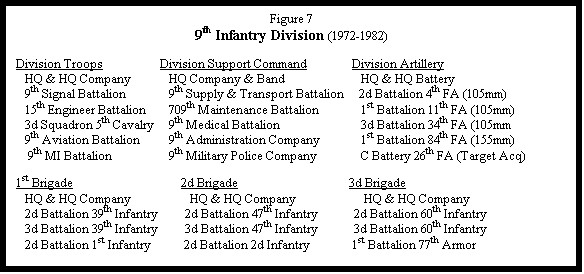
The division’s maneuver structure was initially more conventional than
when it went to Vietnam in 1967. Because
the traditional hosts of some of the Army’s oldest regiments were no longer
active, battalions of the 1st and 2d Infantry and 77th
Armor replaced the 4th Battalions of the 39th and 47th
Infantry and the 5th Battalion 60th Infantry.
6-31st Infantry was reactivated as part of the 7th
Infantry Division at Ft Ord the following year and later moved to Ft Irwin,
California where it became the infantry component of the National Training
Center’s Opposing Force. Most
other elements of the division were initially the same as those that had served
with the division in Vietnam.
General Creighton Abrams, appointed the Army’s
Chief of Staff after the war, set out to rebuild the Army from its post-war low
of 13 divisions and make it ready again to fight if called on.
The first division he reactivated was the 9th Infantry
Division, unfurling its colors at Ft Lewis on April 21, 1972.
The division’s maneuver structure was initially more conventional than
when it went to Vietnam in 1967. Because
the traditional hosts of some of the Army’s oldest regiments were no longer
active, battalions of the 1st and 2d Infantry and 77th
Armor replaced the 4th Battalions of the 39th and 47th
Infantry and the 5th Battalion 60th Infantry.
6-31st Infantry was reactivated as part of the 7th
Infantry Division at Ft Ord the following year and later moved to Ft Irwin,
California where it became the infantry component of the National Training
Center’s Opposing Force. Most
other elements of the division were initially the same as those that had served
with the division in Vietnam.
In
1982, the 9th Division was converted from a standard infantry
division to an operational test bed or field laboratory to explore new
equipment, tactics, and organizations. Funding
problems hobbled the effort from the start.
Although the Army Staff was able to overcome some of the resulting
acquisition problems, legal obstacles to off-the-shelf acquisition limited the
division’s usefulness as a test bed. Moreover,
the division was a hybrid that no single branch school would champion as its
own, leading to lower priority status. By
1988, budget cuts forced the elimination of the division’s 2d Brigade.
In its place the 9th incorporated the Washington National
Guard’s 81st Mechanized Infantry Brigade.
The reorganization gave the division 2 light infantry battalions, 2
mechanized infantry battalions, three tank battalions, and four motorized
combined arms battalions (each with 2 rifle companies and an antitank company).
Although aspects of the new structure would shape the thinking of a
future generation of leaders, the division lasted only 3 more years.
It was inactivated at Ft Lewis on December 15, 1991.
World War II
Vietnam
Algeria-French Morocco
Counteroffensive, Phase II
Tunisia
Counteroffensive, Phase III
Sicily
Tet Counteroffensive
Normandy
Counteroffensive, Phase IV
Northern France
Counteroffensive, Phase V
Rhineland
Counteroffensive, Phase VI
Ardennes-Alsace
Tet 1969 Counteroffensive
Central Europe
Summer-Fall 1969
Winter-Spring 1969 (3d Brigade only)
Winter-Spring 1970 (3d Brigade only)
Sanctuary Counteroffensive (3d Brigade
only)
Counteroffensive, Phase VII (3d Brigade only)
Decorations (shown
only to brigade level):
Belgian Fourragere
Belgian Army Order of the Day for action at the Meuse River
Belgian Army Order of the Day for action in the Ardennes
Republic of Vietnam Cross of Gallantry with Palm 1966-1968
Republic of Vietnam Cross of Gallantry with Palm 1969
Republic of Vietnam Civil Action Honor Medal 1st Class 1966-1969
Presidential Unit Citation DINH THUONG PROVINCE (1st Bde only)
Presidential Unit Citation MEKONG DELTA (2d Bde only)
Valorous Unit Award BEN TRE (3d Bde only)
Valorous Unit Award SAIGON (3d Bde only)
Medals of Honor (** indicates posthumous
awards):
World War II:
·
Herschel F. Briles**, C Co
899th Tk Dest Bn
·
2LT John E Butts, E Co 2d Bn
60th Inf, near Cherbourg, France, 19 Jun 1944
·
T/Sgt Peter J. Dellesondro,
E Co 2d Bn 39th Inf, near Monschau, Germany, 22 Dec 1944
·
William L. Nelson**, 60th
Inf,
·
Carl V. Sheridan**, K Co, 3d
Bn 47th Inf, near Aachen, Germany, 26 Nov 1944
·
LTC Matt Urban, HQ 2d Bn 60th
Inf, Normandy, France, 17 Jun 1944
Vietnam:
·
SGT Sammy L. Davis, C Btry
2d Bn 4th FA, near Cai Lay, Dinh Thuong Province,18 Nov 1967
·
SP4 Edward A. Devore**, B Co
4th Bn 47th Inf, Gia Dinh Province, 17 Mar 1968
·
PFC James W. Fous**, E Co 4th
Bn 47th Inf, Kien Hoa Province, 14 May 1968
·
SSG Don J. Jenkins, A Co 2d
Bn 39th Inf, Kien Phong Province, 6 Jan 1969
·
SGT Leonard B. Keller, A Co
3d Bn 60th Inf, Ap Bac, Long An Province, 2 May 1967
·
SP4 Thomas J. Kinsman, B Co
3d Bn 60th Inf, Vinh Long, Vinh Binh Province, 6 Feb 1968
·
SP4 George C. Lang, A Co 4th
Bn 47th Inf, Kien Hoa Province, 22 Feb 1969
·
PFC David P. Nash**, B
Co 2d Bn 39th Inf, Giao Duc, Dinh Thuong Province, 29 Dec 1968
·
PFC Clarence E. Sasser, HHC
3d Bn 60th Inf, Dinh Thuong Province, 10 Jan 1968
·
SP4 Raymond R. Wright, A Co
3d Bn 60th Inf, Ap Bac, Long An Province, 2 May 1967
9th
Infantry Division Duty Stations:
·
1918-1919
Cp Sheridan, Alabama
·
1940-1942
Ft Bragg, North Carolina; Ft Dix, New Jersey
·
1942-43
French Morocco, Algeria, Tunisia, Sicily (Combat Service)
·
1943-44
England
·
1944-45
France, Belgium, Germany (Combat Service)
·
1945-47
Germany (Occupation)
·
1947-54
Ft Dix, New Jersey
·
1954-56
Germany (Occupation and NATO Service)
·
1956-62
Ft Carson, Colorado
·
1966
Ft Riley, Kansas
·
1967-70
Vietnam (Combat Service)
·
1972-91
Ft Lewis, Washington
Temporary Wartime Attachments:
World War II:
·
746th Tank Battalion
13 Jun 1944-10 Jul 1945
·
629th Tank Destroyer
Battalion
16-25 Aug 1944)
·
899th Tank Destroyer
Battalion
19 Jun-24 Jul 1944
·
376th AAA Automatic
Weapons Battalion
13 Jun 1944-26 May 1945
·
413th AAA Gun Battalion
20 Dec 1945-3 Jan 1945
Vietnam:
·
H Battery 29th Artillery
(Searchlight)
24 Mar 1967-1 Jun 1969
·
6th Battalion 77th
Field Artillery (105mm)
20 Jul 1968-15 Jul 1969
·
214th Combat Aviation
Battalion
15 Jan 1967-15 Jul 1969
·
39th Cavalry Platoon
(Air Cushion Vehicle)
1 May 1968-30 Sep 1970
·
1st Battalion 16th
Infantry
1-31 Oct 1968
·
E Company 50th Infantry
(Long Range Patrol)
20 Dec 1967-1 Feb 1969
·
E Company 75th Infantry
(Ranger)
1 Feb 1969-12 Oct 1970
·
43d Infantry Platoon (Scout Dog)
19 Aug 1967-1 Jun 1969
·
45th Infantry Platoon
(Scout Dog)
19 Aug 1967-12 Oct 1970
·
65th Infantry Platoon
(Combat Tracker)
15 Feb 1968-15 Jul 1969
·
335th Army Security
Agency Company
12 Jan 1967-31 Jul 1969
NOTE: Many other units supported the 9th Infantry Division in combat, but were neither attached nor assigned to the division. The above listing reflects only those units that were officially attached.
Return to the SONID Main Page
Return to the 15th Engineer Main Page - only for those visiting from the 15th Engineer Web Site (do not select if you came from the SONID Main Page)
For SONID visitors who wish to visit the 15th Engineer Web Site please select 15th Engineers